Media: What I'm Reading, Watching, and Listening To
When I worked for the Corps, after we got sent home for COVID, I started a Teams channel for sharing recommendations on streaming content. This quickly led to me including impressions of books I was reading as well. This page is something of a continuation of that.
When my wife and I lived in Portland, we had one of those neighborhood libraries-on-a-stick. You know the kind: where people take and leave books for free. Like most, it consisted primarily of romance novels and religious tracts, so it wasn't very interesting. But after moving to King City I found the local library-on-a-stick also contained worthwhile reads. So with an easy and steady supply of decent books, I started reading more, and more broadly, than when I had to choose and buy books on my own.
Also, in 2025 I discovered that not only was there a local C. S. Lewis Society chapter, but three of them: Newberg, Beaverton, and Salem. Salem was a ways to go, and Newberg was on a break until fall, so I started with Beaverton, later joining the Newberg group as well. This further expanded my horizons, especially since the Beaverton group includes lots of Lewis-adjacent literature like Chaucer, Chesterton, Grahame, MacDonald, Tennyson, and Williams; and their December meeting is always devoted to recommendations.
Note: the following are just my own impressions of things I've engaged with recently. I'm not an author, producer, musician, or professional reviewer, so I don't necessarily know what I'm talking about. If I didn't like your favorite book, show, or album, or if I liked some trash you can't stand, don't despair: I'm just some rando on the Internet.
5-Jun-2026
 King Solomon's Mines by H. Rider Haggard, 1885
139/670 pages. Walter J. Black; Hardcover, 1928.
No ISBN
[the full volume comprises Cleopatra, She, King Solomon's Mines, and Allan Quatermain]
Having previously read She, I found many similarities in the (earlier by about a year) novel King Solomon's Mines. Both books involve Englishmen traveling into remote regions of Africa, meeting lost civilizations, facing intense danger and hardship, and escaping with less than they had hoped for. It's easy to see this novel's influence on later works by authors like Edgar Rice Burroughs (Barsoom, Tarzan), Robert E. Howard (Conan), Michael Crichton (Congo), and even Abraham Merritt. Surely many a pirate or adventurer's tale (whether in text or on screen) has been influenced by this, the first of Haggard's adventure novels.
It's actually a bit surprising how well done it is, being a something of a prototype (though Robert Louis Stevenson had already written Treasure Island, which Haggard said inspired him to write Mines and other fiction for boys). It is not as involved as She, and as such is a lighter read, and better suited for younger audiences. Like She, it purports to be a first-hand account of events as narrated by the principal character, in this case Allan Quatermain.
Also like She, it reflects some, but not all of the Victorian attitudes toward "lesser races". At one point, an Englishman and a native woman fall in love, but even she (who has never seen a white man before, much less been exposed to English colonial culture) intuitively discerns their incompatibility, and laments that they can never be together. The narrator even relates that her subsequent death, though heartbreaking, is also fortuitous in that it avoids the catastrophe that would inevitably occur were she to return with her beloved. And the predicted tragedy seems to go beyond mere societal disapproval, as if such a pairing were somehow inherently improper and inviting calamity. Yet Haggard also makes it clear that his African characters are as heroic as his Englishmen (sometimes more so), and eschews racial slurs explicitly. He's walking something of a line between prevailing attitudes and the notion of equality of races, yet is not ready to give up segregation. Enlightenment ideals push him one way, but the presuppositions of British Empire push him the other, and he makes the same kind of compromise a majority of the U. S. Supreme Court would make more than a decade later in Plessy v. Ferguson: that the races are indeed equal, yet should remain separate.
Fortunately this is just part of the context, and not at all the thesis of the book. Almost all of Haggard's narrative focuses on the adventure itself, which is taut and attention-keeping. We know our hero will survive (after all, he has lived to relate the story), but how this will come about, and what triumphs and tragedies he will experience along the way are kept just out of view. Meanwhile, the mysteries of an ancient civilization, the life of its successors living in its shadow, and the potential for the renewal of a primitive, idyllic existence fire the imagination. An early example of the "thriller" genre, King Solomon's Mines remains a worthy read. Recommended.
1-Jun-2026
 A Fish Dinner in Memison by E. R. Eddison; 1941.
318 pages. E. P. Dutton; Ballantine paperback, 1st printing, 1968.
No ISBN
This is the second book in the Zimiamvian trilogy, and I'm realizing that I lack the educational and cultural background to give the series much of a critique. There are so many overt and implicit references to classical poetry and myth, and (again in this volume) untranslated French, that I am certain I'd understand it better if I were literate in these. The Greek quotations are (usually) translated, but still carry a raft of associations lost to the uninitiated.
Eddison's prose style is also prone to allusion and oblique references, which often made it difficult for me to discern exactly what was happening. One extended passage describes the interaction between a man, his friend, and his house maid, wherein we slowly come to realize that someone has died, that the person is probably his wife, and that he may be methodically planning to do something rash. Only in a later chapter are these suspicions actually clarified. Add to this the multi-world nature of the narrative (Europe c.1908-1940 and Zimiamvia), and the mysterious connection between characters in these distinct realms, and it's hard to tell sometimes who is doing what where, and whether doing so affects both worlds.
It's not at all that the writing is bad — it's that it is difficult. Perhaps Eddison should be read more for the experience than the story. There are a lot of long, descriptive passages that aren't very important to the story, and tend to distract my short, 21st-century attention span from the larger narrative. I'm not sure what to do with passages such as this sunset (pp. 58-9):
Something seemed to stir in the warm air, with the falling tones of her voice: a languorous opening, rising and falling and closing again, of some Olympian fan. As it should have been sunset beholding the going up of Night, the Duchess stood and beheld her: as to say:— You and I are one: the same common sky: one air: beauty, colour, fire. Night is young, rising in her ascendant while sunset dies: Night, kirtled with blackness and a steely glitter of stars: bat-wings; owl-wings soundless as the feathered wings of sleep; and, coming and going in unplumbed pools of gloom, pairs of eyes, bodiless, like green moons, and the soft breathing of snakes that glide by invisible. So Night enters on her own, bitter-sweet with a passion of nightingales; and all presences of earth and air and water cover their faces before her: young (young enough, the Duchess said in herself, to have been my daughter), yet far older than all these: older than light: older than the Gods. But sunset, too, has her climacteric, renewed at every down-going: flowering into unimagined fire-shadows, as of some conflagration of the under-skies where all dead splendours and lovelinesses past and gone are burnt up with their own inward fire, and the red smoke of it is thrown upward in rays among incandescent mists, and overhead heaven is mottled like a kingfisher's wings, turquoise and gold and greenish chrysolite more transparent than air; and the sea spreads to a vast duskiness of purple on which, as on the dear native bosom of their rest, all winds fall asleep.
or this description of an alpine ridge (p. 114):
Seen through that haze of air and the down-shedding radiance of the sun, the millions upon millions of tons of living rock seemed as if refined away to an immateriality of aery outsides, luminous, turquoise-shadowed, paler and thinner than thin clouds, yet immovable and sharp-outlined like crystal. It was as if slab, gully, scree-slope, buttress, and mile-long train of precipice wall, cut off from all supports of earth and washed of all earthy superfluities which belong to appearances subject to secular change, stood revealed in their vast substantiality; the termless imperishable eidolon, laid up in Heaven, of all these things.
when they demand such attention to unwind, occur with such regularity, and serve primarily as additional color. They're beautifully rendered, but break up the narrative (or dialogue) so completely that I find it hard to appreciate both them and the story in the same reading. Coupled with periodic and unannounced changes of venue between the worlds (sometimes by dream-like segue), and frequent references to characters solely by title or relation (which can be confusing unless you're paying close attention), it is difficult at times to keep track of who's who and what's happening where.
All that said, there are some great passages in the book, and some intriguing ideas presented. The agony of losing a spouse is palpably rendered in evocative prose; and the magic-realist concepts of worlds within worlds and the uncertainty of which is foundational are thought-provoking. I get the very real sense that the book is better than I can appreciate — a wine too refined for my coarse palate. Yet I can only recommend this book if you are willing to take the chance of gleaning only a portion of what it has to offer.
24-May-2026
 The Concept of Morals by W. T. Stace; 1937.
307 pages. Macmillan; Peter Smith Hardcover, 1975.
ISBN: 0-8446-2990-1
I got this book many years ago, I don't recall where, but it was probably free and sounded interesting. I finally got around to reading it this week, and it actually was interesting. The author takes issue with both ethical relativism and ethical absolutism, leaving the reader to wonder what's left. The answer lies in how Stace defines these terms. He relegates absolutism to the notion that individual mores ("do not steal") are universal and inviolable, applying to all people at all times regardless of circumstance. And he defines relativism as the notion that all moral judgements are relative to their cultural context, with no conceivable way to judge between or improve them. This leaves him a good deal of leeway in between, and I think puts him in the company of the bulk of humanity, outside of a few philosophers and radical pacifists.
Stace claims to hold to the notion of "radical empiricism", which he defines as declaring that any statement is meaningless unless it can conceivably be verified by experience. Again, he is careful with his wording: "conceivably" doing most of the heavy lifting here. It is not, as many "fellow" radical empiricists of the relativist stripe maintain, that statements that can't be verified by anyone are meaningless. Instead, in order for it to be meaningless, the statement must be unfalsifiable in principle, such that no being, even God, could possibly experience it. Again, I think he's made what sounds like a strong statement, which in practice only distinguishes him from a few esoteric philosophers, and not the great mass of people.
While dismissing absolutism (as he has defined it) out of hand, Stace goes on to explain in detail the ethical relativism prevalent in philosophy in the 1930s. He takes care to point out where he disagrees with it, but is generally quite fair in his presentation. He then moves on to his own formulation that there is a morality universally applicable to humans, which derives from their peculiar human characteristics.
In order to maintain his assertion that there are no unconditional uses of the word "ought" (which I don't think he spends enough time nailing down), he ties morality to the happiness of people, so that one "ought" to be moral if one wants to be happy. And universalizes this by noting that all men at all times want to be happy — that is, to satisfy their own impulses — and that this is essentially a given, since any motivation can be recast as a satisfaction of some desire. This dodge is perhaps necessary to avoid contradicting himself in other writings, but in this book effectively says that there is an unqualified "ought", at least for humans.
He is very clear that his theory of morals is incomplete, compatible with any number of other systems (including those that maintain that morals are given by a Creator, flow from that Creator's nature, or the nature of creation itself), but that he cannot illuminate that which he cannot see, and refuses to speculate what lies beyond his limited view. The epilogue consists of a dialog between himself and two friends who have just listened to him read his manuscript. One who attributes morality to the nature (or design) of the universe, and the other a relativist. They poke holes in his presentation and give him the opportunity to explain the limited scope of his view. In the end, he maintains he has shown what morality is at least, and that it may well be (and probably is) much larger. He rejects the relativist's assumption that what cannot be seen does not exist, and on this basis maintains that his thesis in no way speaks to whether a theistic (or pantheistic) view is correct or not.
Stace is careful to give a fair account (when he gives an account at all) of other theories, even if he disagrees significantly with them. There are a few places he elides over problems (some, I think, serious), or fails to make important distinctions, but on the whole this is a very cogent introduction to both ethical relativism and how morals might instead derive from the human condition. Recommended.
23-May-2026
 Avalon by Roxy Music.
Hybrid SA-CD. 5.1 multichannel. 11 tracks, 42:47
Virgin Records; 1982.
SA-CD Remaster, ROXYSACD9; 2003.
UPC: 7-24358-38712-4
Partly because of the Arthurian legends I've been reading, I put on an old favorite last night and turned it up. Roxy Music's Avalon is their final and most popular album, and this multichannel SA-CD release is one of the rarest and most valuable I own, but I'm not about to part with it. I was only 13 when this album came out, and not one for spending my limited cash on music, but I still have fond memories of standout tracks at junior high dances, on the radio, and MTV. When this disc came up in a lot of 90 on eBay many years ago, it factored heavily in my bid.
The real treat here is the multichannel remix and the added resolution of SA-CD. The surround mix allows for greater separation between instruments and much better clarity than the standard CD. Surround effects are appropriate and tasteful throughout, and the dynamics are astounding.
Some highlights: "More Than This" benefits mightily from the surround remix, with the signature toms landing both fore and aft; "The Space Between" is beautifully dynamic and envelops the listener completely; melodic "Avalon" is cavernously spacious; and "The Main Thing" simply demands your attention. This is a great album even on redbook CD, but if you get a chance to hear the surround version (now also available on Blu-Ray*), do it. Highly recommended.
*The only thing the SA-CD has that is missing from the Blu-Ray is the bonus track "Always Unknowing" which, while produced and mixed to the same standards as the rest of the album, is long and not quite as good as the other tracks. I can see why it was left off of the original release.
18-May-2026
 The Pilgrim's Regress by C. S. Lewis; 1933.
211 pages. Eerdmans; Deluxe Illustrated Edition, 1981.
ISBN: 0-8028-6063-X
The Newberg C. S. Lewis Society powered through the final two "books" of this volume last Wednesday — too quickly for my taste, but we were up against the summer break. Re-reading this classic has only made me more fond of it. Written in just a few weeks, it nonetheless relates a decade or more of careful thought on philosophy, aesthetics, sin and redemption.
This semi-autobiographical allegory follows "John" from his harrowing upbringing in Puritania, across the landscape of early twentieth-century thought, through surrender to God, and back across that same territory (now changed) to the place he started, yet could not have found by remaining. He is driven by a childhood vision of an Island where wisdom and beauty manifest uncorrupted, the very desire of which is more satisfying than the fulfillment of any other want. Along the way John (and his moral sense, Vertue) come face to face with both beguiling and dismaying philosophies in the harsh and bitter North as well as the indulgent and dissipating South. Finding none of them wholly satisfactory, they eventually consent to be helped across the Grand Canyon of sin by Mother Kirk (the Church, broadly speaking), only to discover that John's island is actually on the other side of the world, and he must go back and cross the brook of death just past Puritania to reach it.

The allegorical presentation is at times difficult to unwind, partly because its touchpoints are peculiar to the philosophical thought of the 1920s and 30s in England. My edition has running headlines at the top of each page to help the reader along, as well as Lewis' 1943 afterword, but not the explanatory notes of the Wade Annotated Edition, which proved helpful at times during the discussion. There are a lot of references to classical literature, sometimes in Latin or Greek. We lay readers were fortunate to have a classical educator on hand to help with both pronunciation and interpretation, but some self-guided Internet research will get you most of the way there if you are wondering what a name or phrase is meant to convey.
This is one of the few works I know of by Lewis that includes poetry, and despite what I've heard critics say, to my mind it's not bad at all. I put a lot more stock in saying something meaningful than in pure aesthetics, but I find Lewis' verse even artistically to be above average. Most of the truly bad poetry I've read (I'm looking at you Suzanne Somers and Leonard Nimoy) doesn't have much to say, then says it badly. Lewis has a great deal to convey, and does so with the brevity and clarity that verse affords. A few of the poems were later revised and can be found in Poems (1964, Harcourt Brace Jovanovich; edited by Walter Hooper). I think the updates improve them artistically, while also clarifying their meaning.
I was the one who proposed we read this book last fall, so it's not surprising that I should here give it my highest recommendation. It's not an easy read, and should probably be taken in small bites, with periodic reflection. If you have the option, I'd get the Wade Annotated Edition — I may have to get one myself to see the fulness of its insights. But whatever edition you may find, I highly recommend this book.
17-May-2026
 The Once and Future King by T. H. White; 1958.
647 pages. Penguin Books; Second Ace Trade, 2011.
ISBN: 978-0-441-02083-6
On the heels of Tennyson's Arthurian verse, I thought it was a good time to tackle White's prose on the same subject. I had always heard this book spoken of in reverent tones as a classic, but I was not prepared for it to be such an amalgam of varied styles and tones. Part of this may derive from it being written as four separate works from 1938 to 1940, with the fourth part only being published in this 1958 omnibus volume. Curiously, I didn't detect such stylistic drift in Tennyson's Idylls, despite them being written over a much longer period of time. But Tennyson seems to have been trying to hew to an idealized medieval mindset, while White was exploring alternate interpretations.
The following highlighted paragraphs are summaries of the four books. If you want to avoid spoilers, skip past them to the last paragraph.
The first book, "The Sword in the Stone", tells of young Arthur's childhood and tutelage under Merlyn. I was surprised at both how modern and how silly it is. Young Arthur ("The Wart") has experiences that are described in terms of modern artifacts, like telescopes and toy rockets. And Merlyn, moving in some sense backward through time, has accumulated some modern items, yet none from the author's future. This book hit me a bit like the movie First Knight, where anachronistic music and cultural references are blended with medieval tournaments and court intrigues, yet no one in the story notices. I found this distracting and a bit irritating. While White probably intended the modern references to make the narrative more accessible, for me they made it less so. To have no common frame of reference with the characters made it difficult to immerse myself in the story.
The second book, "The Queen of Air and Darkness" is darker in tone. Arthur, at Merlyn's suggestion, modifies the code of war (which to this point has been rule by power) into the ideal of chivalry we normally associate with Arthurian legend. Knights of the Round Table are to be gentle in court and ruthless in war, but only to use force when the cause is just — to right a wrong, defend the innocent, rescue a damsel, etc. There's a fair bit of philosophy about the nature of war and how the common man pays the greatest price for it. In battle, Arthur attempts to minimize this tragedy by riding past ill-equipped peasants to attack knights directly, rather than just slaughtering serfs as usual. This unorthodox tactic wins him the day and the title of King of England. But the book also retains some silly elements, like Sirs Grummore and Palomides disguising themselves as the Questing Beast to get King Pellinore to resume hunting it instead of pining for a princess. The real Questing Beast falls in love with the pair, and Merlyn, with his retrograde experience of time, suggests they "psychoanalyse" her.
The third book, "The Ill-Made Knight", concerns Lancelot primarily, and continues the darker tone while dispensing with most of the whimsy. It is not without its insights, like how Lancelot's innate cruelty and selfishness, and his subsequent desire to master these cause him to contend with his feelings for Guenever instead of mortifying or fleeing from them, thereby setting the stage for their illicit affair. It includes a story about Lancelot being tricked into fathering a child (who will become Sir Galahad) by the maiden Elaine, whom he has just miraculously rescued. Distraught at his loss of virginity (and, he believes, the ability to do further miracles), Lancelot loses his wits, roams the countryside for years, and is finally taken in as a court fool by Elaine's father. Elaine eventually recognizes him and nurses him back to sanity. He subsequently leaves for Camelot with a promise to return one day. Many years later, after their son Galahad has taken the Holy Grail to Babylon, never to return, Lancelot visits Elaine. On learning he will not stay with her forever, she kills herself.
The fourth book, "The Candle in the Wind", tells of the breaking of the Order of the Round Table. In this version, Mordred is Arthur's illegitimate son by Margause, his half-sister, and the rest of the Orkney clan her sons by Lot:

Aware of Lancelot and Guenever's affair, but maintaining plausible deniability, Arthur informs them of Mordred's parentage, and how Arthur had attempted to kill him Herod-style by decreeing that all babies born at the appropriate time be drowned. He indicates that Mordred knows of this failed attempt, hates Arthur for it, and may try to overthrow him, perhaps by scandal [hint, hint]. Guenever and Lancelot do not take the threat seriously, but soon thereafter Mordred and Agravaine come to Arthur privately and accuse the pair of adultery. In order to maintain integrity with respect to his own law, Arthur refuses to use his kingship to protect his best friend and wife, and agrees to go on a hunting trip so their accusers can catch them in the act. Agravaine, Mordred, and 12 other knights succeed in catching Lancelot in Guenever's room, but despite being unarmed, Lancelot kills Agravaine in single combat, takes his armor and sword, then kills the remainder en masse, save only Mordred, whose arm is broken. Arthur must obey his own laws, and decrees that Guenever burn at the stake. Lancelot has fled, but everyone knows he's going to try to rescue her, and Arthur is counting on it. Indeed, Lancelot succeeds, but in the fight kills Gareth and Gaheris, both unarmed. Largely to avenge these two, Arthur and Gawaine besiege Lancelot's castle in France, leaving Mordred in charge of England. Lancelot gets the Pope to intervene, and Guenever is permitted to return to England, where Mordred fakes a communique from France saying that Arthur and Lancelot are dead, usurps the crown, and announces he will marry Guenever. Arthur lands in England, and just prior to the final battle with Mordred, bids a young page named Tom to not fight, but to return to Warwickshire and keep the idea of peace (like a candle) alive despite the winds of history. [Thomas Malory, who wrote Le Morte d'Arthur in 1485, likely lived in Warwicksire.]
Throughout the book, there is a curious mix of archaic language on the one hand, and anachronisms (both as descriptive similes and actual story elements) on the other. I got the nagging sense that White is both trying to show off his knowledge of history and language, and challenging the reader to sift fact from fiction. As a result, I found I couldn't take any declaration, even when explicitly given as a correction to modern misconception, as reliable. Is White giving a cheeky reinterpretation of some historical tidbit, or does he mean to reveal a forgotten or buried truth? In the end, it's hard to tell what's plausibly objective and what is just White's opinion. The story gets progressively more serious, and by the end is actually quite good. But I have trouble forming a cohesive opinion about what is not a terribly cohesive book. Despite its successful adaptations (Disney's The Sword in the Stone and Lerner and Loewe's Camelot) and many influences on such writers as Moorcock, LeGuin, Kay, Rowling, and Grossman — or perhaps because they set so high a bar — I found The Once and Future King somewhat disappointing. Not recommended unless you can overlook these issues.
4-May-2026
 Idylls of the King by Alfred, Lord Tennyson; 1833-74.
395 pages. Henry Altemus 1896 edition; Hardcover, ~1925.
No ISBN
The May selection for the Beaverton C. S. Lewis Society. This small volume was the only copy available at Powell's, but is in pretty good shape for being about a century old. It gives no publication date, but new releases advertised in the back pages lead me to believe it dates from the mid-1920s. The text itself is available from many sources, including Project Gutenberg. This Altemus edition seems to be available at archive.org.
At first, I started writing out summaries of the various stories, but these are probably better got from more scholarly sources. I don't know the Arthurian legends very well, and probably miss a lot of connections that Tennyson assumes his reader (being an educated 19th-century Englishman) knows. So I'll instead focus on the form of the stories, which is the real innovation and delight of this book.
The medieval concepts of chivalry and courtly love are evident throughout, both assumed in the exposition and displayed in the dialog between characters. It seems high-minded and almost alien by 21st-century standards, but I imagine this was the point even in Tennyson's time — a balm to soothe the abrasions inflicted by tough-minded materialism and then-nascent modernism. For example, Pelleas refuses Gawain's help to fight all three of Ettare's knights at once, because he is sure that if his cause is true, he will prevail. And his eventual loss of faith is not in this universal justice, but in the faithfulness of the knights and ladies of Arthur's court. A modern man would say a just cause has no bearing on the outcome of a battle, and would not expect anyone to hew unfailingly to such high standards of chivalry. We enlightened ones know that life is unfair and our heroes fallible. How refreshing it is to read of people steadfastly aspiring to something more noble.
The poetry is first-rate. Writing in blank verse (with meter but not rhyme) forces an economy of language and careful choice of words that (in the mind of such a great poet) result in breathtakingly apt imagery. The meter is largely iambic, but to put too much emphasis on it seems to me to break the flow of the verse, as sometimes in Shakespeare. I found it helpful to read the passages aloud (usually at a whisper to avoid disturbing or perplexing my wife or neighbors) with little emphasis, as though they were prose. I found phrases broken across lines read more smoothly this way, though the capitals at the start of each line sometimes made recognizing them challenging. As with The Dream of Gerontius, sometimes elisions of certain words are assumed and not explicit, making first-run recitation difficult. For example, the final stanza reads:
Thereat once more he moved about, and clomb
Even to the highest he could climb, and saw,
Straining his eyes beneath an arch of hand,
Or thought he saw, the speck that bare the King,
Down that long water opening on the deep
Somewhere far off, pass on and on, and go
From less to less and vanish into light.
And the new sun rose bringing the new year.
To my ear, line 2 "Ev'n" and line 5 "op'ning" are implied, and too much emphasis on meter obscures how "saw .. or thought he saw" are connected. Plus, it makes the final line sound odd — not quite Lou Reed odd ("New York City is the place where...") — but you get what I mean. I'll be interested to hear next week what everyone at the Lewis Society thinks.
UPDATE: As usual, the text was variously received by people at the Lewis Society. Most appreciated its rendition of courtly love and chivalric standards, but some found the verse tiring and the alternate spellings irritating. It seems everyone's prior experience with Arthurian legend was somewhat at odds with this telling. As with other kinds of mythology, without any authoritative sources to fall back on, it's up to each author's (and reader's) interpretation what constitutes a good or bad read on the legend. As for me, I recommended it both for its presentation of the chivalric ideal and its brilliant poetry.
2-May-2026
 The Enemy by Lee Child, 2004.
408 pages. Bantam Books; Bantam Trade Paperback, 2025.
ISBN: 978-0-440-42300-3
The library-on-a-stick yielded up yet another Jack Reacher novel, this one a flashback to Reacher's days as a major in the Army MPs. He has been suddenly and inexplicably reassigned from Panama to North Carolina just prior to New Year's Day, 1990. Noriega is on the run in Panama, and the Berlin wall is coming down, so things are shaking up all across the Department of Defense. A major general is found dead of a heart attack in a by-the-hour motel 30 miles from Reacher's new post at the (fictional, as far as I can tell) Fort Bird. The general was on his way from Germany to an armored cav conference in California, which everyone involved now insists had no agenda whatsoever. But the general's briefcase is missing, and Reacher suspects it contains conference details people do not want found. Traveling to distant Green Valley, NC to inform the general's wife of his demise, Reacher discovers she has been beaten to death by an intruder just hours after her husband's death. Returning to base, he discovers that his CO has been abruptly reassigned to Korea, and is incommunicado. Then, a Delta Force sergeant is found bludgeoned to death on post, and the new commander orders Reacher to classify the murder as a training accident. Reacher must walk the line between seeking justice and plausibly following orders, sometimes crossing the line into outright insubordination. Whatever's going on involves powerful people who are willing to subvert justice, ruin careers, and kill to get their way.
For most of the book, Child balances Reacher's ethical dilemma well, such that even when Reacher pushes the envelope, you question his actions while understanding his perspective. And circumstances rarely line up in such a way as to make these decisions easy — that is, Child doesn't make his own job easier by invoking fate, as his collaborations with his younger brother sometimes do. While some aspects of the mystery are foreseeable, mostly you're just as much in the dark as Reacher, and the story unfolds naturally as he (and you) learn more. All in all, this is one of the better Reacher stories I've yet read. I don't know if it's better than Bad Luck and Trouble, but it's better than Past Tense, or the Lee/Andrew collaborations I've read (The Secret and In Too Deep). Recommended.
26-Apr-2026
 Joan Armatrading by Joan Armatrading.
Hybrid SA-CD. Stereo. 10 tracks, 41:32
A&M Records; B0027716-06, 1976.
Remaster from ½" safety copies: Intervention Records; IR-SCD5, 2020.
UPC: 707129-301475
I had heard of Joan Armatrading, and the influence she had on even better-known artists, but I'd never sat down and listened to her. I'd just previously listened to Nina Simone's Little Girl Blue, and, while I recognized its importance and was able to hear some of the new directions it took jazz vocals, it just didn't live up to my (admittedly high) expectations. This disc was just the opposite. I was expecting some innovations that hadn't reached their full form yet, like what I'd heard on Little Girl Blue. What I got was full-flower talent and a tour-de-force of instrumental virtuosity. Admittedly, this eponymous album is her third studio release, while Simone's was her first, but I was still struck by the immense contrast. Armatrading is not just a great vocalist — her guitar work is outstanding. I can hear echoes of her influence in acts as diverse as the Talking Heads, Fleetwood Mac, and guitar virtuoso Al DiMeola. She really should be a bigger star. Highly recommended.
25-Apr-2026
 Live ad Alcatraz by Fausto Mesolella.
Hybrid SA-CD. Stereo. 9 tracks, 44:18
Fonè Jazz: SACD136, 2013.
UPC: 8-012871-013654
Another loaner disc from my good friend Dave, and another recording that fills the room with sound using only the front two speakers, though the SA-CD format allows for five plus a subwoofer. Mesolella (and pedal steel guitarist Ferdinando Ghidelli on some tracks) perform an all-instrumental set live in a small venue at the Free University of Alcatraz in Italy (not the former prison in San Francisco). The crowd is seemingly potted up only for the applause between tracks, and is confined to a narrow center, while Mesolella and Ghidelli are afforded the full soundstage.
While all the instruments are amplified, most of the songs are played in an acoustic-electric style with a good deal of dynamics. The long rendition of "O Sole Mio" is an exception, and features a wide variety of acoustic and effects-laden electric stylings — Mesolella really pulls out the stops and rocks out on this one. And Ghidelli's pedal steel is the only instrument I can hear on "Amazing Grace". Everything else, whether covers or original compositions, is primarily acoustic-electric or electric with subtler effects.
The first track, "Sonatina Improvvisata d'Inizio Estate" reminded me of a lot of "These Streets", the title track of the 2011 breakout album by Paolo Nutini, who, despite his very Italian name, is in fact Irish. It's a catchy melody, so much so that I had Nutini's lyrics stuck in my head even after the disc finished. Some unlikely covers actually work quite well, including Piazzolla's "Libertango", "Somewhere Over the Rainbow" from The Wizard of Oz, and Michael Jackson's "Black or White", which I'd forgotten was co-written by Bill Bottrell, whom I first knew as producer on Toy Matinee's eponymous and only album, but who has worked with some of the biggest names in popular music.
Live ad Alcatraz is not the virtuoso showcase that Masterpiece Guitars is, but is the kind of concert I'd pay to see in person. Recommended.
20-Apr-2026
 A Wind in the Door by Madeleine L'Engle, 1973.
211 pages. Dell Publishing; Paperback, 15th printing, 1983.
ISBN: 0-440-48761-7
I never read A Wrinkle in Time as a child, despite many efforts to get me to. I saw fiction generally as irrelevant (why read things that aren't true?), and was further discouraged by other kids' enthusiastic declarations about the book. I was told smugly and definitively that the fourth dimension is time and that the fifth dimension is a wrinkle in time. Already I knew that this was only one possible formulation, and mistook my classmates' dogmatism for the author's. Indeed, I never bothered to pick up a copy and read it later in life, either. Then this sequel appeared in the library-on-a-stick, and I figured it was time to see what the hubbub was about.
Indeed, Wind carries the not-too-subtle arrogance of the Smart Kids™ that initially discouraged me from reading Wrinkle. Part of this is understandable: kids (like everyone) want to be exceptional despite their everyday appearance. They fantasize about secretly being royalty, or wizards, or mutant superheroes — this sort of thing is common to (successful) children's literature. And generally there's little danger in this, since kids aren't likely to convince themselves that their cherished hopes are really true. But when your superpower is smart, or more accurately, knowledgeable, you run the risk of becoming a grade school gnostic. As one of the "smart kids", I struggled with this myself: the suspicion that all your problems are due to others' ignorance and refusal to acknowledge your superiority. That the world would be better off if everyone just listened to you. That there was not only an objective Best View of things, but that it was easily recognizable given enough smarts, so everyone would agree on it. Wow, did I have a lot to learn.
As the New York Times Book Review on the back cover notes, the book indeed "mixes classical theology, contemporary family life, and futuristic science fiction", though I am less impressed that they are with the result. Indeed there is a (singular) cherubim, which appears (like in the Old Testament) as a swirling storm of wings, eyes, smoke and flame. There's kything, an advanced form of mental telepathy, which children find easier to pick up than adults. The universe is populated with persons, including animals, aliens, stars, trees, and "farandulae" (as near as I can tell an invented sub-particle of mitochondria*). And there is good versus evil: "echthroi" (Greek for "adversaries, enemies, foes"; from ἔχθω, "to hate") are fallen angels intent on "un-Naming" all things out of existence — and pretty much everyone else at least starts out against them. There is one oblique reference right at the end where the main character, Meg, seems to identify in herself the same evil that corrupts the echthroi, but it's not very clear.
In my estimation, the theology is too pantheistic to map well to Christianity or Judaism, though I understand L'Engle to have been a Universalist Christian, much like George MacDonald. The book seems influenced by the spirit of the late 60s and early 70s, as expressed by, say, the Moody Blues or psychedelic-informed philosophers. I still haven't read A Wrinkle in Time, but if it's like this sequel in tone, I can see why it was popular with the public school teachers I had in the 70s — and why it won a Newbery award. The "we are all one, everything is connected to everything else, and if we can just get everybody to love one another, we can bring about Utopia" vibe is strong. As is the iron assurance that intellect and high culture will lead the way. While I don't believe it was her intent, the author could scarcely have pandered to 1970s grade school librarians any harder. Not recommended unless this is your bag, baby.
*And further evidence of my theory that George Lucas is bad at hiding his inspirations, in this case for "midichlorians", tiny self-willed inhabitants of living cells that, though never mentioned before The Phantom Menace, suddenly everyone knows are the conduit for the Force.
16-Apr-2026
 In Too Deep by Lee and Andrew Child, 2024.
324 pages. Delacorte Press; Hardcover first edition.
ISBN: 978-0-593-72580-1
Another Jack Reacher collaboration by brothers Lee and Andrew Child, In Too Deep is better than The Secret, but still not up to Lee Child's better solo efforts.
I sensed some plot problems early on that turned out to have explanations quite late in the book, but since no one else in the narrative caught on, for most of the book I had concerns that they were simply overlooked errors or misunderstandings. I can't fault the authors for not tying up these loose ends, but they are hidden amongst what turn out to be so many irrelevant details that it's hard for me to fully exonerate them, either.
Writing thrillers is hard. You can't sandbag the reader with new information that completely changes the plot — that's not very satisfying. New info has to illuminate prior knowledge in such a way as to validate it while giving it fresh meaning. Ideally, the reader has an "aha!" moment where they realize how prior clues relate to the story. You must constantly walk the line between revealing too much and telegraphing your plot twists, and hopelessly befuddling your reader with a thicket of ambiguous details. The very best stories keep these "degrees of freedom" in the plot to a minimum, and succeed by misdirection, the way a talented illusionist does in his magic act. Now, a magician typically entertains by leaving his audience wondering how he did it, but he can only do this because he is constrained by shared reality. For a fiction author, it's the easiest thing in the world to write a surprise ending that could not be deduced by any amount of effort. So he must instead reveal how cleverly he hid the truth in plain sight in order to satisfy the reader. The Child brothers err too far (or so it seems to me) on the side of snowing the reader to keep him guessing, though it could also be that I'm tired this week and not tracking as well as the average mystery fan. So In Too Deep gets middling marks from me on this axis.
One plot point turns on all the characters (including tons of FBI agents) misunderstanding now Non-Fungible Tokens (NFTs) work. I was almost to the end of the book before I realized I wasn't in the alternate Reacher universe where this misunderstanding is correct. Which was kind of disappointing as well - I wasn't sure whether I was supposed to have esoteric knowledge and see through the plot point, or supposed to learn along with all the characters the true nature of NFTs. Neither possibility is particularly satisfying.
In Too Deep mercifully avoids the Hollywood girl boss tropes evident in The Secret. While the female lead is tough and smart, she's not Marvel superhero (or villain, as in The Secret) caliber. Reacher is, of course, a hyper-competent fighter and investigator, but he, too, stays in his lane. It's clear he knows little to nothing about everyday technology, much less NFTs, and is unapologetic about it. There's the usual glossing over of the long-term consequences of his, shall we say, "hands-on" approach to justice, but at this point I consider that part of the genre, and can't really call it out as a flaw.
In short, In Too Deep is just an okay Reacher novel. It's probably best enjoyed passively: don't think too hard about the details and let the story reveal itself, the way you would in a movie theater. But to do so is to not expect much from the text. Alternately, trying to manage all the variables is challenging, and many of them turn out to be irrelevant, which is disappointing in its own way. Only recommended if you just want something to take up a few hours on a plane ride or while waiting to be called from the jury pool.
12-Apr-2026
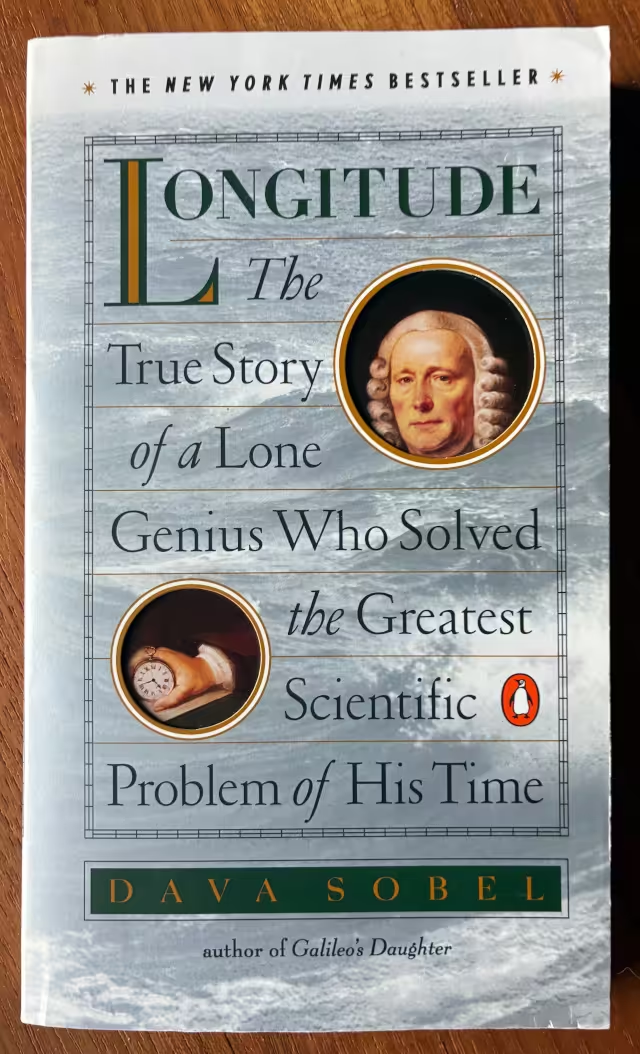 Longitude: The True Story of a Lone Genius Who Solved the Greatest
Scientific Problem of His Time by Dava Sobel, 1995.
Longitude: The True Story of a Lone Genius Who Solved the Greatest
Scientific Problem of His Time by Dava Sobel, 1995.175 pages. Penguin Books; Trade, 18th printing.
ISBN: 0-14-025879-5
Years ago I saw a short documentary on the problem of accurately determining longitude, and its eventual solution by the development of resilient timepieces. So when I saw this slim volume (likely the source material for the film) in the library-on-a-stick, I picked it up. It is a popular treatment of John Harrison's development of a chronometer both accurate enough, and impervious enough to motion, temperature, and humidity, to keep time on long sea voyages. It relates in layman's terms both how accurate timekeeping can solve for longitude, as well as many of the technical and political obstacles that hindered Harrison both in realizing his ambition and receiving due credit for it. Sobel throughout uses historical anecdote to illustrate her points, including the seriousness of the problem of longitude, the resources brought to bear to solve it, the bizarre approaches put forth, and the cutthroat politics employed to tilt the balance toward favored proposals. Harrison is revealed as the singular genius who spent decades perfecting just five timepieces for this task, and yet received only partial credit for his achievement during his lifetime. It's a very easy read, and avoids the unnecessary injection of invented detail used by Grann in Killers of the Flower Moon. To me, this feels more respectful of the reader. But still, this is intended only as a popular book, and is not copiously noted like Grann's. Sobel gives a short bibliography, in which the reader may seek further detail, at the end of the book, after acknowledging the people most helpful in informing her account.
I enjoyed Sobel's presentation, felt I learned a little bit, and have resources to consult should I wish to delve further. For the level of elucidation it represents, Longitude does extremely well. Highly recommended.
10-Apr-2026
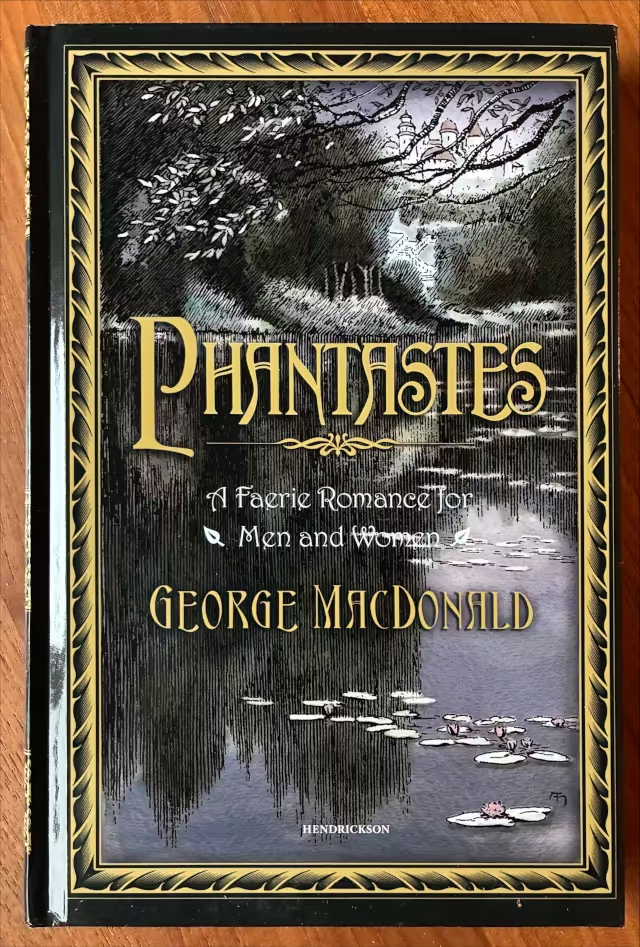 Phantastes: A Faerie Romance for Men and Women by George MacDonald,
1858.
Phantastes: A Faerie Romance for Men and Women by George MacDonald,
1858.232 pages. Hendrickson; Hardcover, fifth printing, 2025.
ISBN: 978-1-59856-667-3
This April selection for the Beaverton C. S. Lewis Society is MacDonald's first novel, and is widely considered foundational to modern fantasy. Lewis Carroll, G. K. Chesterton, and C. S. Lewis all cite MacDonald as an inspiration. He is also credited with influencing Tolkien, L'Engle, and David Lindsay. I found a particular consonance between Phantastes and Lindsay's A Voyage to Arcturus. Both novels feature highly fantastical settings with all but jump-cut transitions between them. While this whipsaw narrative conveys the strangeness and dreamlike quality of MacDonald's Faerie (and Lindsay's Tormance), it also detracts noticeably from the flow of the story. I found it helpful in reading both books to forgo trying to understand their grand structure, and instead try to absorb the varied settings and sub-stories almost as an anthology of related tales.
There are a number of stories and songs, mostly rendered in verse, throughout the text. Sadly, the poetry is not that good. Besides metrical problems, many of the poems (to my reading) wander and are not careful in their word selection. The general consensus at the Lewis Society meeting was that one does not read MacDonald for the prose, much less for the verse. One unfortunate attendee chose an audio version of the book in which the narrator composed and performed his own music for the songs. The melodies and accompaniment served only to compound difficulties with the lyrics, and the listener was eventually driven to skip past them.
Broadly speaking, the story goes as follows: having come into his inheritance at 21, the protagonist Anodos finds his way to fairy-land and spends 21 earthly days (but an untold length of time to him) exploring it and interacting with its inhabitants. He is seeking after the Ideal, and for most of the narrative does so by pursuing beautiful women. While he is frequently given advice as to how to proceed, I can't recall an instance where he does not promptly ignore it. Yet things always work out anyway, and indeed he matures significantly despite — or even because of — his recklessness. While I understood that a character heeding warnings and avoiding unseen dangers wouldn't be very interesting storytelling, Anodos still felt to me like a pathologically irresponsible hero. But this became less surprising on discovering (at the Lewis Society meeting) that MacDonald, a minister, was a universalist who believed that all men will eventually be drawn back to God, and that all rebellion will in the end only serve to reveal the still-open path to redemption. While this is a theology I can certainly hope for, it is one I fear to rely upon. It seems to me that a night is coming when no man can work, notwithstanding the possibility that one might also become so corrupt as to finally and irrevocably reject God. Of course, my fears could be ill-founded, but they are mine and I must contend with them.
This is not to say that Phantastes is an apologetic or theological text. It's a fairy story, which entails having parallels to our world, and a moral; but it stubbornly resists being stretched over an allegorical frame. The themes of the novel seem to be that giving (not getting) love is itself the true reward, that humility is both freeing and fulfilling, and that whatever the circumstance, good will ever be the final result. While all these can be derived from Christianity (even without universalism), there is no clear connection in the text itself. The principles are instead grounded in the nature of creation (both Faerie and Earth) with no reference to a Creator.
Recommended for its significance, hopeful outlook, and ability to convey the numinous character of Faerie, but alas not for the writing.
29-Mar-2026
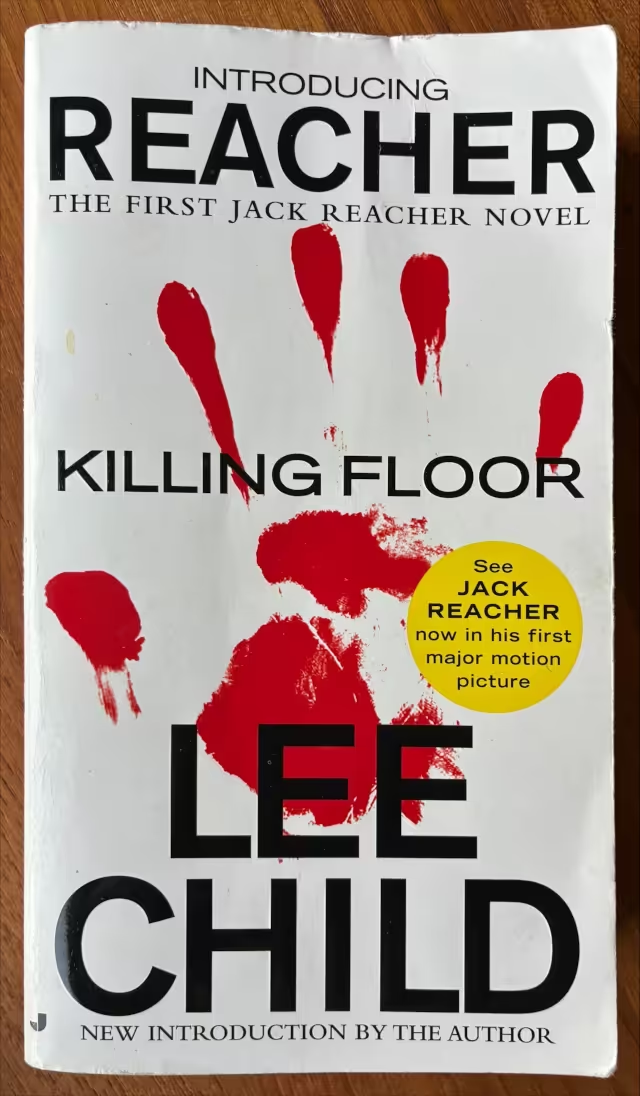 Killing Floor by Lee Child, 1997.
524 pages. G. P. Putnam's Sons; 2nd Jove paperback, 1st printing, 2012.
ISBN: 978-0-515-15365-1
Another Jack Reacher book — actually Child's first novel — which was later used as the basis for season 1 of the television series. Reacher is a bit more "Mack Bolan" in this introductory volume than he ends up being in later books and the TV series. Not that anyone he kills didn't already kill someone else, try to kill him, or otherwise kind of have it coming (sometimes a bit too conveniently), but as a former Army MP, Reacher has surprisingly few qualms and seemingly no legal concerns over extra-judicial homicides. There's a good deal of movie-like disregard for consequences generally, but these mostly don't come to a head until the denouement, since the circumstances up to that point are so extreme as to warrant rash behavior. Call it a a pet peeve, but to my mind, the reset to factory defaults at the end of the book doesn't bear up under even casual scrutiny. I get that this is to some extent a feature of the genre, but Child does it better in books like Bad Luck and Trouble or even Blue Moon. Still, I'd put this book above The Secret, which has plausibility problems, and Past Tense, which I disliked for its ick factor. Killing Floor is not bad, but doesn't represent Child's full talent as a writer. Mildly recommended if you're into the genre.
25-Mar-2026
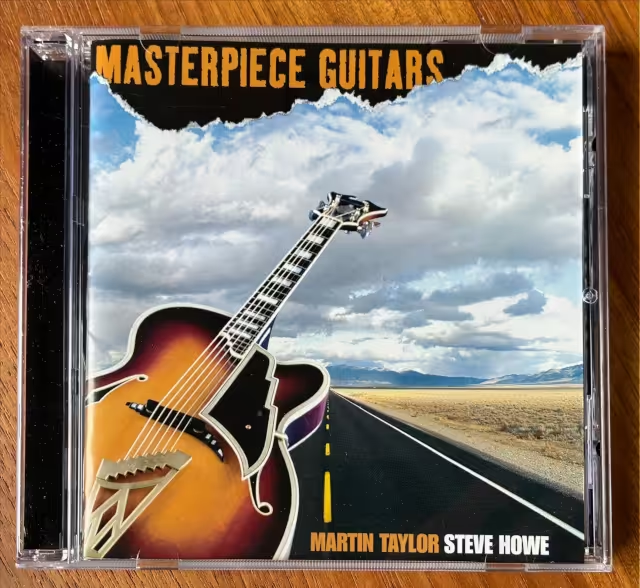 Masterpiece Guitars by Martin Taylor and Steve Howe.
Single-layer SA-CD. Stereo. 17 tracks, 60:31
Sony Music Japan: SIGP 38, 2003.
UPC: 4-547366-011609
A good friend stopped by after I retired with a couple of gifts (Bill Evans' Sunday at the Village Vanguard and Grant Green's Grantstand), and a shoebox full of other high-resolution music to borrow. This was one of the loaner discs, and is to me a clear standout. Sadly, the current price for a copy on eBay is $150, so I will not be ordering my own. The album centers on a large collection of rare and fine guitars (and related instruments like mandolins and harp guitars), with each song styled to match the instruments employed. The owner of the collection, Scott Chinery, proposed the disc in the mid-1990s, and it was likely recorded around 2002.
Martin Taylor is a true virtuoso of the guitar, with the versatility to pick up a few (or 19!) different guitars for a single track, and play them each in a style appropriate to the instrument. Steve Howe (formerly of Asia, GTR, etc.) is no slouch, either, but limits himself to two "solo" tracks and five collaborations, the remaining ten tracks featuring only Taylor.
Masterpiece Guitars is a tour de force of mostly fingerstyle guitar work encompassing jazz, folk, country, and rock. Each track showcases a particular guitar or set of guitars from Chinery's vast collection, so there's a good variety. The sonics are absolutely amazing, especially for a stereo-only recording. Clearly this is a labor of love for both the players and the engineers. Instruments are clearly defined, but the net effect is still a room-filling sound. For guitar aficionados, the particular instruments are listed for each track, along with their player and spatial location in the mix, so they may be conclusively identified. Many are specimens of guitars never before recorded; some of them pre-date the phonograph itself. A truly enjoyable, one-of-a-kind recording.
As a single-layer SA-CD, this disc is not playable on a standard CD player, but an inexpensive CD version is available as well. I may have to console myself with one when I'm forced to relinquish this astounding disc. Highly recommended.
24-Mar-2026
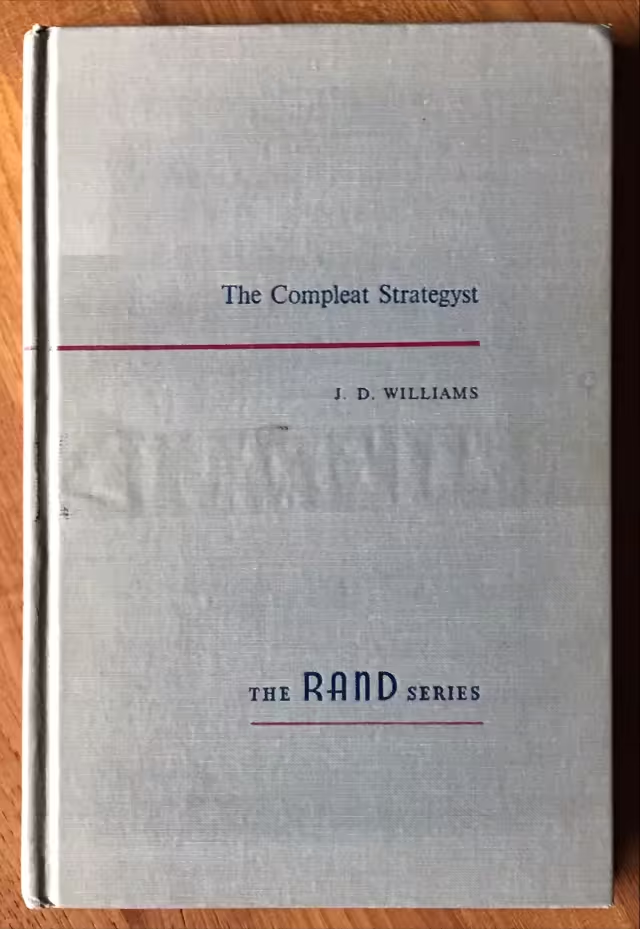 The Compleat Strategyst by J. D. Williams, 1954
234 pages. RAND Corporation; Hardcover, 10th printing.
No ISBN. Library of Congress #53-9007.
A popular introduction to game theory from the 1950s. It reminded me a bit of Darrell Huff's How to Lie with Statistics (also from 1954), both in its tone and fanciful illustrations. While nominally a popular text, it's clear from the introduction that it is intended for a somewhat erudite, though not necessarily technical, audience. The language is that of the cultured professional, even if it assumes no mathematics beyond basic arithmetic.
In practice, it is more involved than Huff's book, with a good deal of theory and plenty of exercises for the reader who wishes to try out the methods presented. While matrices are used throughout to codify the two-player games pertinent to the book, none of the usual vector or matrix operations are necessary to apply the techniques, though at times they get tantalizingly close. Findings requiring higher mathematics are presented, but not explained. For example, a proof exists (but is not given) that all perfect-knowledge games have optimal single (or pure) strategies for all players. Chess is such a game, since the positions of all pieces are known to both players at all times. Therefore, an optimal pure strategy exists for white an another for black — we just don't know what they are or what result they produce (a win for white, for black, or a draw), and if we did, the game would cease to be interesting.
I started by doing all the exercises, which are helpful for cementing the analytical methods introduced in the book. But as the problems became more involved, I updated my strategy to include simply trusting that the harder ones also had ready solutions.
I'm sure the field has progressed markedly in the 72 years since its publication, not the least because of our ability to automate the tedious math with our ubiquitous computers, but The Compleat Strategyst remains an approachable introduction to a fascinating and highly applicable field of study. Recommended.
22-Mar-2026
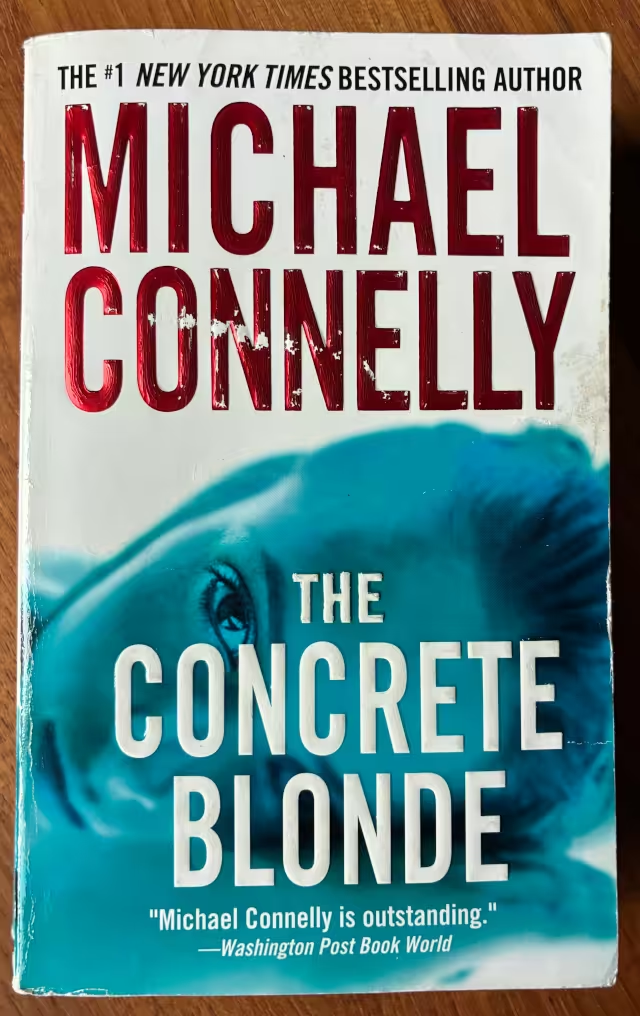 The Concrete Blonde by Michael Connelly, 1994
500 pages. Grand Central Publishing; Paperback, 6th printing.
ISBN: 978-0-446-61758-1
Yet another Harry Bosch mystery from the library-on-a-stick. It is the earliest Connelly work I've yet read, and is slightly less polished than his subsequent books, but still exhibits his transparent narrative style. Like all good mysteries, there is some misdirection as we follow Harry's investigation, but a few seemingly salient details get dropped in the process. I can't tell if this was done on purpose, whether their resolutions got cut in editing, or whether Connelly started with one idea, then went a different direction in the end. It feels a little like Chekhov's gun never went off, but the overall story is still satisfying. Readers familiar with the Bosch television series will notice how some characters and circumstances differ from those in the book. I suspect this was done to keep the suspense fresh in the series without compromising the overall tone, but I can imagine other reasons as well. Another good mystery by a very good author. Recommended.
18-Mar-2026
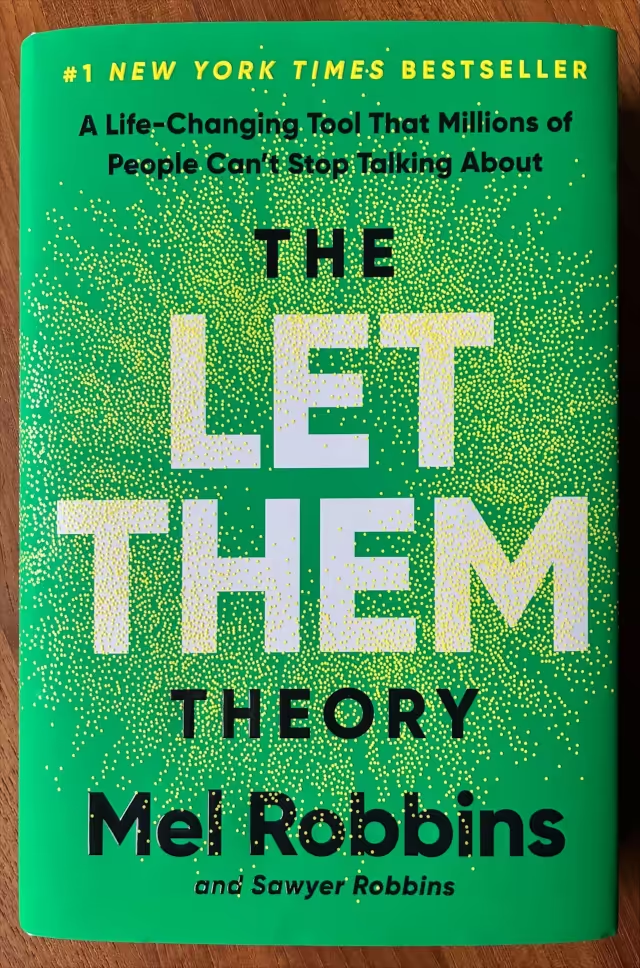 The Let Them Theory by Mel Robbins and Sawyer Robbins, 2024
322 pages. Hay House; Hardcover, 35th printing.
ISBN: 978-1-4019-7136-6
This is a self-help book from TEDx presenter and podcaster Mel Robbins with help from her daughter Sawyer. Its principal message is that letting others' expectations drive your decision making is futile and ultimately counter-productive, and that instead you should focus on living up to your own standards and living a life you respect.
The first section introduces the "Let Them" mantra, and to a lesser extent its companion "Let Me", which together comprise the theory. As is common in self-help books, Robbins (no relation to Tony that I can find) then tells you all the things the theory is going to do for you in a motivational-speaking kind of way. Next, she addresses a number of possible objections and pitfalls to implementing the theory. To me, it seemed an odd time to bring this up, since she hadn't really fleshed out the theory yet, but it's a minor quibble.
Then she gets into describing the theory and how to apply it in a number of common situations. She makes no claim of originality, and indeed it sounds a lot like the Stoicism of Epictetus or Aurelius — just not quite so strident. The real benefit of Robbins' book is in providing examples and practical applications. One can read the Stoics and begin applying their philosophy by imagining all your family dead and yourself exiled and maligned. Robbins starts you off much more practically by pointing out that you can't control how other people react to you or their own circumstances; it's not your job to manage others' feelings or ensure they approve of you, yet most people do this to some extent or another.
Along the way, Robbins gives advice on handling negative emotions and the tendency to compare one's life with others'. Regarding comparisons she recommends, instead of envying people for their accomplishments, finding in their example a roadmap to attain similar success. I had a friend who admired accomplished guitarists so much that he never tried to learn himself. He could never imagine attaining their mastery, so from his perspective trying was pointless. I think Robbins would counsel him that his heroes probably felt the same way about their own role models, but persevered and reached their own kind of mastery. To put a Scott Adams frame on it, you might not be the best all-around guitarist in the world, but you could still be the best at combining a particular set of talents that include guitar.
Concerning emotions, she explains how to avoid reacting to negative emotions and instead allow them to dissipate before deciding what to do.
When you feel your emotions rising up, Let Them. Allow the
anger, the frustration, the hurt, the disappointment, the sadness, the
grief, the tears, and the feelings of failure come up. Let
Them.
And then, Let Me not react. Don't reach for your phone. Don't
turn on the TV. Don't make a drink. Don't open the fridge. And for
crying out loud, don't text anyone. Just notice the feelings and Let
Them rise up.
The reason why you must learn how to Let Them rise is that once
they do, they also fall.
This reminded me of nothing so much as the litany against fear from Dune, and is essentially the same concept.
I must not fear.
Fear is the mind-killer.
Fear is the little-death that brings total obliteration.
I will face my fear.
I will permit it to pass over me and through me.
And when it has gone past I will turn the inner eye to see its path.
Where the fear has gone there will be nothing.
Only I will remain.
Both Robbins and Herbert acknowledge that emotions are states of mind that don't control your actions, and if you let them pass you can decide for yourself how to respond with a clear mind.
The second half of the book is largely devoted to applying the theory to relationships: finding and maintaining adult friendships, motivating (not forcing!) others to make positive changes, doing so when people are struggling with addiction or depression, and finding and nurturing romantic relationships.
All-in-all it's a straightforward presentation of how, in various circumstances, to remain true to your own values and let others act as they will, even if that includes criticizing or looking down on you. The book's value is not so much in its insight — most of this has been said before — but in its demonstration of how to apply the insight to common situations. Recommended.
14-Mar-2026
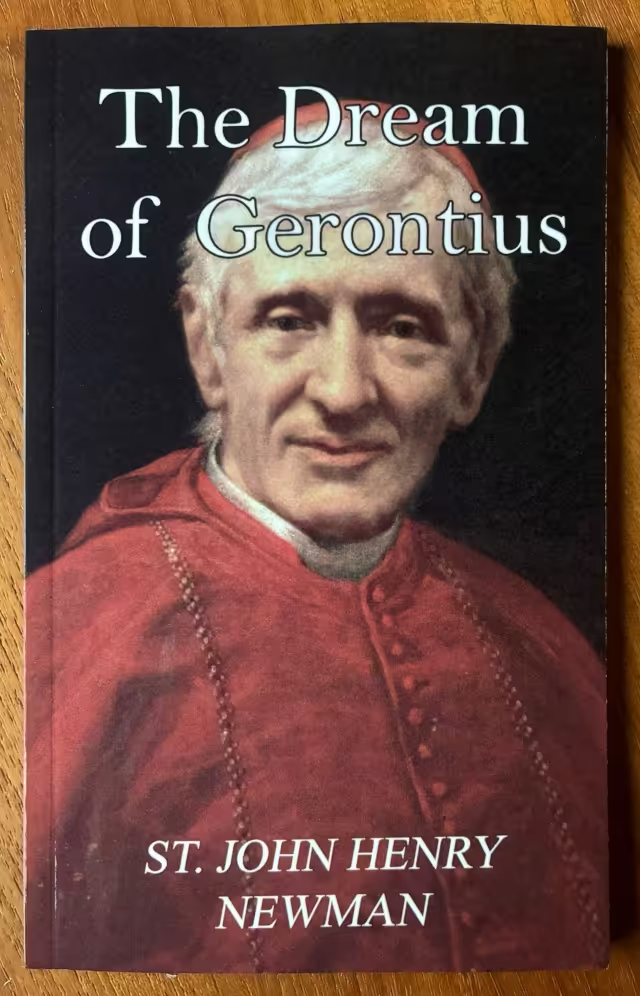 The Dream of Gerontius by St. John Henry Newman, 1865
47 pages. Custom trade printing.
No ISBN
Thursday, That One Catholic Guy™ at the Beaverton C. S. Lewis Society gave us each a copy of this, which was nicely printed on-demand. Last month, we'd had a discussion on the existence and nature of purgatory, and he thought this poem conveyed the Catholic view well. I was aware of (and had possibly even heard, though I do not own) the derivative choral work of the same name by British composer Edward Elgar. My general impression of Elgar is that his works are good, but not the best, and since I own a lot of choral works of various qualities already, I haven't been highly motivated to seek out the piece.
The poem is another matter. Free is a very good price (as Tom Peterson used to say), and it's a short and relatively accessible read (there is some archaic language, but it's mostly discernible from context). It indeed presents a different picture than I'd been given by fellow Protestants of purgatory: not a "temporary hell" where the redeemed are tormented by demons for their sins, but instead a place of convalescence after the subtle, but piercing trauma of seeing the Almighty face to face. This encounter with the Divine disables the disembodied soul and renders it self-consciously aware of its prior sin (though no sin actually remains), and it must recover for an interval, perhaps until the resurrection of the dead when it will be reunited with the body. As if to answer Augustine, an angel at one point suggests how the soul can be outside of time and still experience change.
The poetry is generally good, though I experienced a few metrical issues. Most of these could be mitigated by more consistent use of contractions (e.g. heav'n, quick'ning; though I can't think of a good way to contract being into a single syllable). The reader can elide the extra syllables as he goes, but it's added work and disrupts the flow. The meter is not always iambic, either, though it often is — which makes the oddly-stressed lines stand out even more. I occasionally toyed with an optional rendering, but for many lines it was too difficult to manage without substituting for key words, which would destroy the particular character of the poem.
Recommended if you like the Elgar piece, which is shorter, using only a portion of the material presented here. Also recommended for insight into Catholic doctrine, of which I'm fairly ignorant. Poetry-wise, it's good, but not the best — sort of like Elgar.
12-Mar-2026
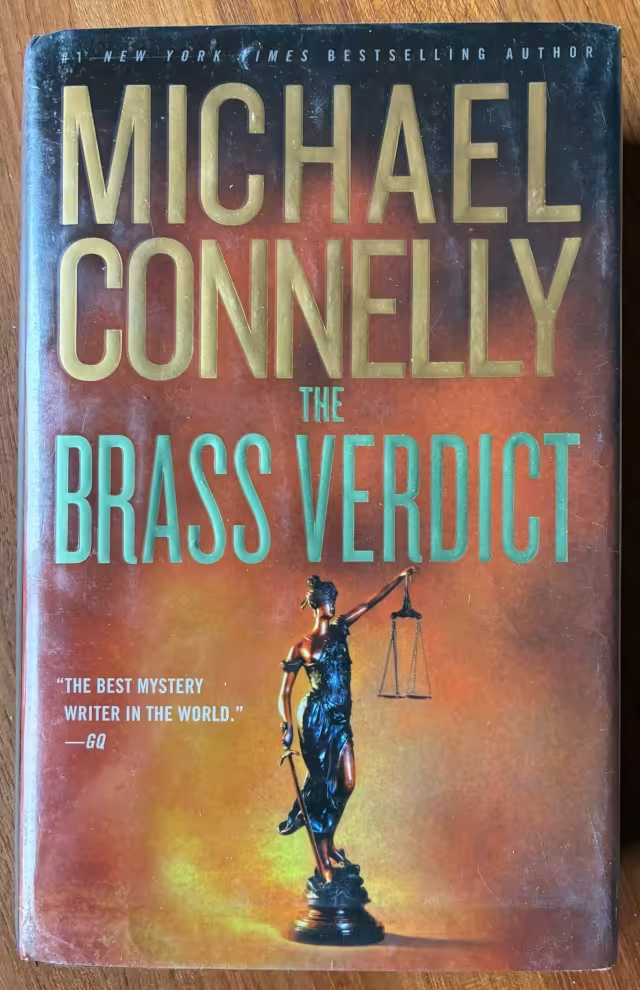 The Brass Verdict by Michael Connelly, 2008
422 pages. Little, Brown and Company; First printing.
ISBN 978-0-316-16629-4
Wow. I've read a few Connelly books before (The Last Coyote, Desert Star, Nine Dragons), and always found them enjoyable. This one brings his Mickey Haller (a.k.a. The Lincoln Lawyer) and Detective Harry Bosch characters together in one story, and it's a doozy. I recently read or heard somewhere that former journalists tend to make good thriller authors, and I certainly agree in this case. I can see why as well: the straightforward, concise narrative required for journalistic work translates directly to the genre. The amount of research one (ideally) needs to do also maps well, plus you have a lot more time to get things right in a novel. I only caught one error (preemptory is used in place of peremptory), and I had to look it up because I doubted my own memory once I saw it used consistently in a best-selling novel. I was delighted to find events I thought unlikely — that might have happened just because the author made them so — turn out to have good explanations later in the narrative. To me, it's a sign of an author who takes his story (and reader) seriously. Once again, I enjoyed the easy, laminar flow of Connolly's narrative. The words almost disappear in the stream of pure story coming off the page. I blew through this volume in just a few sittings, and kept wanting to come back for more. This may be the best Connelly I've read. If you're a fan of the genre, check it out. Highly recommended.
9-Mar-2026
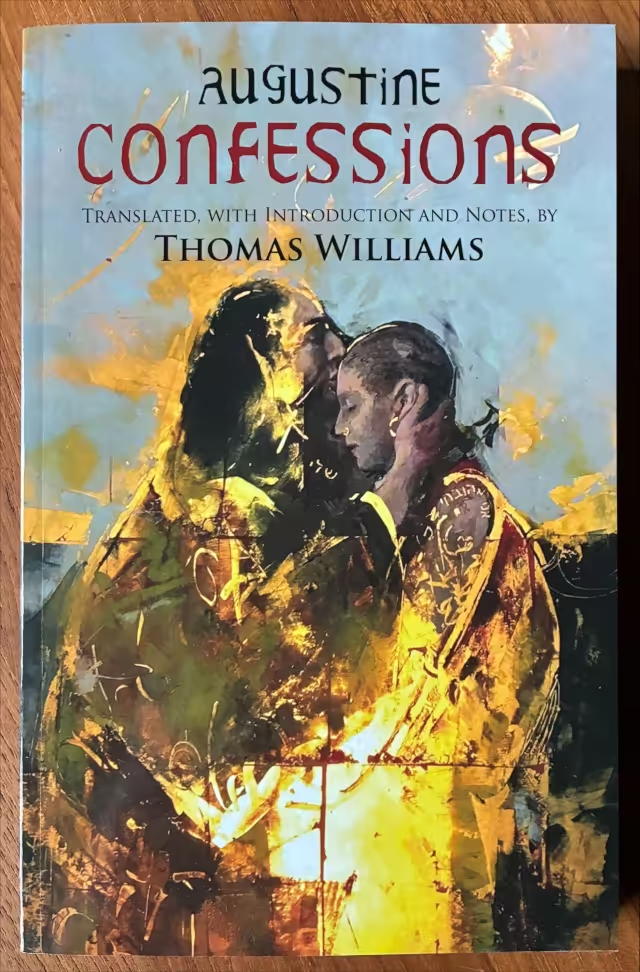 Confessions by Augustine, ~397; tr. Thomas Williams, 2019
305 pages. Hackett Publishing Company; Third trade printing.
ISBN 978-1-62466-782-4
Considering the philosophical importance and theological impact of Augustine's works, I anticipated this would be a long and difficult read, along the lines of St. John of the Cross or perhaps Plato. Parts of it are in fact challenging, but only in the final three books. The first ten I found instead to consist of comparatively straightforward, unguarded, and plainspoken narrative, due in part to Williams' very accessible translation. Augustine pours his heart out to God (and the reader) without an eye to hammering home some unique point or making a name for himself. Indeed, he recants several such prior attempts, even saying at one point he doesn't know what happened to some of his previous books, and doesn't care to look for them. He recounts many of his follies and how God saw him through them all to finally come humbly to embrace Christ and His Church, then ends with three chapters of exegetical commentary on the first chapter of Genesis. It is only here that we get a sample of the philosophical rigor of Augustine's mind. But despite building a specific interpretation of the creation account, he is quick to note that his ideas do not necessarily invalidate others', distinguishing between disagreements on truth versus disagreements on authorial intent. Further, he maintains that to different people the same Scripture may illuminate different truths, all of which remain true, and that people of good will may disagree on what signifies what. His key point is that all should seek Truth, for Truth is not the possession of one person, but for the same for everyone.
"For someone who speaks a lie speaks what belongs only to himself." (12.25.34)
The cover art, depicting the return of the prodigal son, is an apt choice, as Augustine consistently reiterates his own inadequacy and God's relentless mercy toward him. Highly recommended.
28-Feb-2026
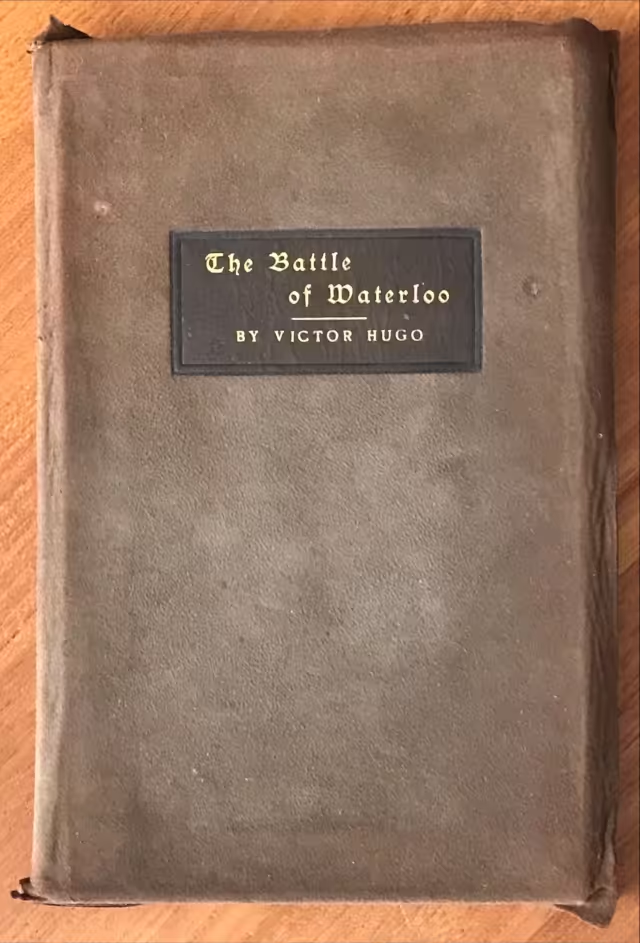 The Battle of Waterloo by Victor Hugo, ~1861; tr. Lascelles
Wraxall, ~1862
The Battle of Waterloo by Victor Hugo, ~1861; tr. Lascelles
Wraxall, ~1862106 pages. The Roycrofters; Leather first edition, 1907.
No ISBN, Library of Congress #11008825.
My Granny got me this book because she knew I liked old books. Not being much of a military history guy, I browsed through it, admired the two-color typesetting, then put it on the shelf as a cool old book. I was also a little concerned about damaging it, as it was already over a hundred years old. But after retiring, I catalogued my old books and recognized I'd never actually read the whole thing. So at 119 years old, I carefully read through it (dear Granny passed at 97). It starts with Hugo himself exploring the modern (1861) site of Hougomont, which he takes care to inform the reader is Hugo-mons, built by Hugo, Sire de Sommeril, presumably his own forebear. After a description of the site, he flashes back to June 18, 1815 and gives a detailed description of the formations and officers on both sides, then an account of the battle, and finally a sort of explanation of why Napoleon lost, despite being the superior general.
Through most of the book, there are references to places and people with which the reader is assumed to be familiar. It's clear Hugo expects you to be familiar with the region and the battle itself already, as probably most cultured Frenchmen were in the middle of the 19th century. But I'm not, so I just had to take his word for it. Which became a problem because, as I read, it became increasingly clear that his account is more than a bit biased. There's a good deal of oblique trash-talking of the Allied officers, attributing victory instead to the bravery and fortitude of the common soldier. But in the end, Fate, not Wellington, is Napoleon's true enemy. Misfortune for France and good luck for the Allies are what turn the tide: the weather, unseen terrain, and a fortunate choice of roads are what thwart Bonaparte's genius. He must fail in order that the Revolution can continue via politics instead of war. Europe is made ready for liberty by Napoleon's empire crushing the monarchs, and when the monarchs return they find they must accept the rights of the people. It's a patriotic spin on the entire era, but I can't take it as anything approaching objective history.
You won't learn anything important about the battle from this scattered and biased account, but you will get Hugo's take on the destiny of Europe and his very 19th-century view of the inevitability of Progress. If this sounds interesting, the Library of Congress has scanned its own copy here.
NB: On looking into details for this review, I learned that some events Hugo relates (particularly the hollow road of Ohain, and Cambronne's stand) are generally rejected as ahistorical. It also appears to constitute the better part of Book I of Part Two of Les Misérables.
19-Feb-2026
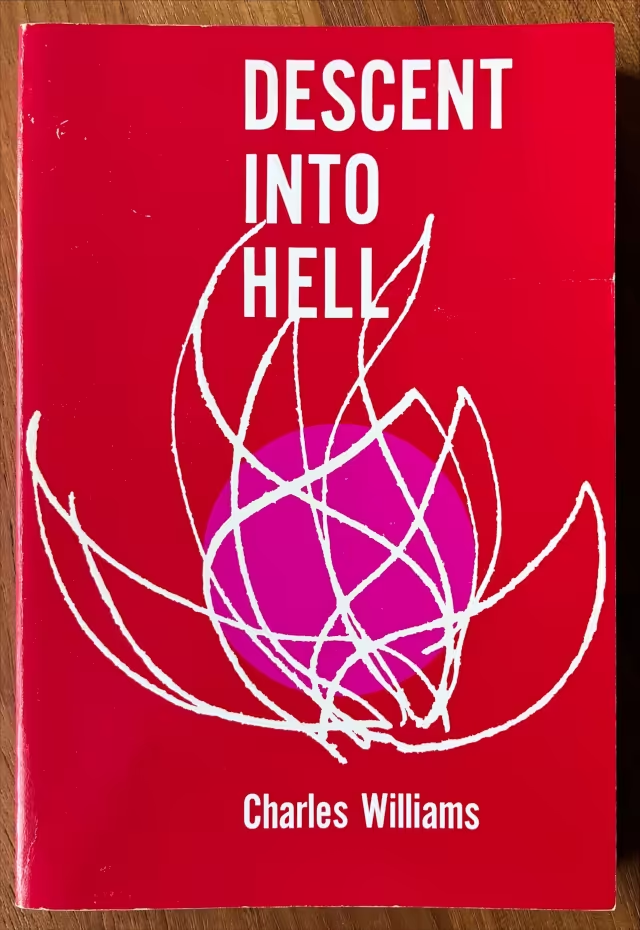 Descent into Hell by Charles Williams, 1937
222 pages. Wm. B. Eerdmans; 1972 trade edition.
ISBN 0-8028-1220-1
This is the March selection for the Beaverton C. S. Lewis Society, and the first Charles Williams novel I've read. I am impressed. It's a challenging read, not because of the vocabulary or literary references, which are on a popular, rather than erudite, level. The difficulty instead is in absorbing the supernatural, almost magical quality of the narrative. The dead, the dying, and many of the living have dreamlike visions that can be as perplexing to the reader as they are to the characters. But Williams vividly captures their mystical and often profound quality, turning them into absorbing reading. People aren't always what they seem, and spirits of all kinds inhabit the streets of Battle Hill. The reader must forgo deciding too quickly who is who and what they're up to — even whether they are a force for good or ill. For much of the novel there are characters that are not easy to classify. Many struggle with fear, envy, lust, and other weaknesses. Some give in while others resist, and it's not at all certain who will persevere to the end. Highly recommended.
P. S. I was told that I'd need to read Thomas Howard's The Novels of Charles Williams in order to understand this book, but I'm glad I went at it "cold" instead. I'm sure I'll get an idea of Howard's interpretation at the March meeting, and I can see how it compares with my own.
P. P. S. The March meeting was good discussion, but those who read the Howard book didn't pull from it any startling new insights. One participant said he could recommend a second reading of the book, but not the first. I understand what he means: you spend so much effort trying to grasp it that you likely miss a lot the first time around. It certainly does merit revisiting.
8-Feb-2026
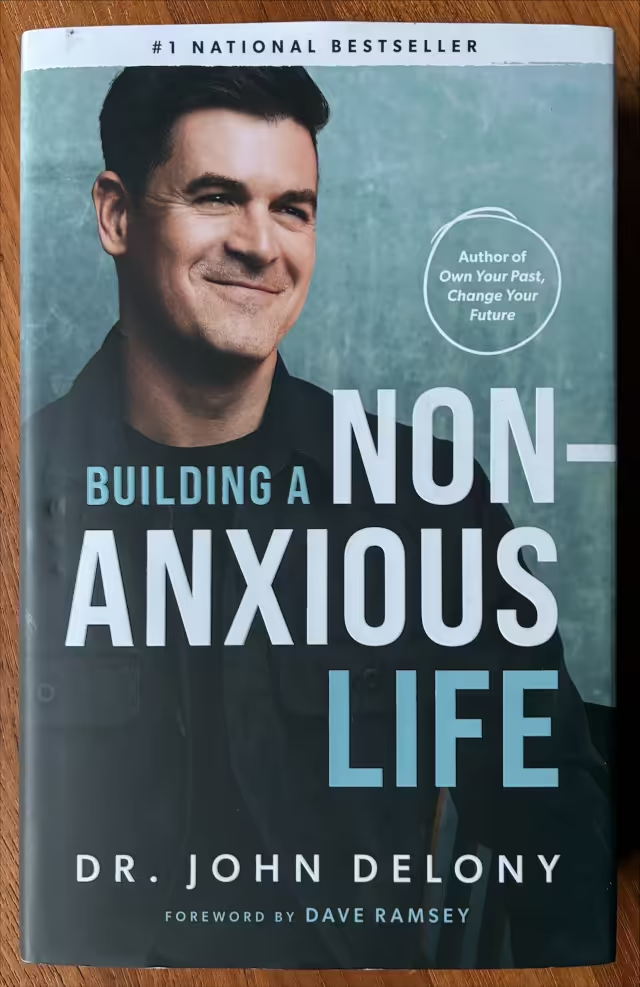 Building a Non-Anxious Life by John Delony, 2023
283 pages. Ramsey Press; 4th printing.
ISBN 979-8-887820-01-9
Being a preternatural saver, I've always liked Dave Ramsey's take on debt, saving and investing. My wife listens to his podcasts all the time, and turned me on to another Ramsey contributor, Dr. John Delony, whose training and background is in psychology. He has a call-in show where people ask mostly for relationship, family, and mental health advice. He gives, in my opinion, pretty good answers and has a lot of real-world experience with what works. While tuning in, I kept hearing about this new book he'd written about anxiety and how to get on top of it, so to speak. I went ahead and ordered it from Amazon, and it arrived, like, the next day.
Like many self-help books, it's an easy read. Even being a slow reader (I hear the words in my head), I knocked it out in a couple of days. It has a lot of good advice on how to get your finances, relationships, fitness, and faith on track. But I couldn't help but feel that it was a bit of a bait-and-switch. Here's what I mean: I was expecting insights into the nature of anxiety and how to combat it directly, but the book essentially zeroed in on reasons for anxiety, and how to correct those. It tacitly stipulates that anxiety is appropriate in a given situation, and can most effectively be addressed by fixing the anxiety-producing circumstance. It is essentially silent on what to do with anxiety about things that aren't particularly worthy of it. These can be anything from neurotic worries to ruminating over potential threats to panicking over minor incidents. I've seen (and experienced) some of these myself, and was hoping for practical advice on handling them.
I can recommend the book for someone who is anxious about real problems, who wants to fix their circumstances in order to give themselves space to relax and have resources available for the inevitable troubles in life. But for someone with free-standing anxiety, it may not be of much help. Recommended with this caveat.
8-Feb-2026
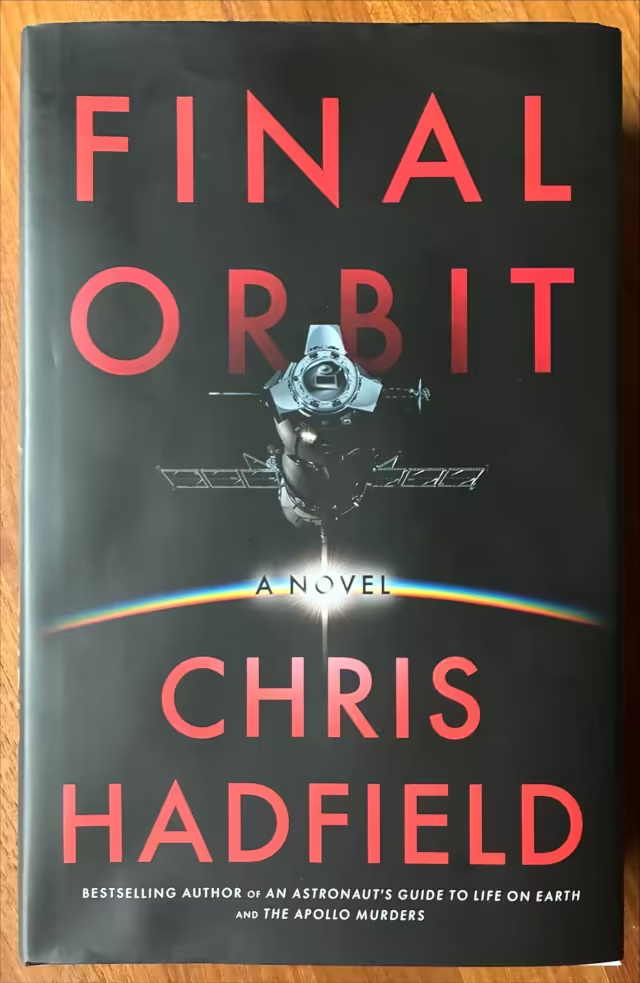 Final Orbit by Chris Hadfield, 2025
407 pages. Little, Brown and Company; first hardback edition.
ISBN 978-0-316-58168-4
Written by someone who was there, and knew a lot of the players in the reality of the Apollo, Soyuz, and Skylab era of the early 1970s, this alternate history is plausible enough to accept, and taut enough to engage. It reads a bit like a faster-paced Tom Clancy — a generic thriller that balances several interacting storylines in Houston, China, and low earth orbit. I recognized a lot of the history, having been interested in space travel as a child at the time, and also some places where it had departed. The female lead, a Soviet cosmonaut, had clearly been involved in other fictional events in a prior book, and walked on the moon with Apollo astronauts. But once I figured that out, I settled back in to enjoy the (now firmly alternative) storyline. While technically solid, the story does get a little loose in places, with certain events not explained well enough to be clearly comprehensible. It's unclear why the Chinese try to detain (but not interrogate or kill) the primary capsule commander for the Apollo-Soyuz mission, or how a spoofed Soviet launch of an anti-satellite missile is meant to facilitate the theft of American particle beam technology from orbit. I'd have to re-read it with hindsight, I think, to follow some of these threads, but I find I don't really care to. Walking the balance between making the plot pleasantly surprising and sandbagging the reader with seemingly random events is tough, and Hadfield unfortunately doesn't do the best job, seeming to err on the side of surprise over clarity. The best instances I've seen of managing this seem to involve distraction and misdirection, rather than obscurity: in the end you see what makes perfect sense, but you never considered because you were so intent on a different train of thought. While I can't say I can do any better than Hadfield, I found myself wanting more from a multiple best-selling author. Not recommended except for immersion in the 1970s space program vibe.
5-Feb-2026
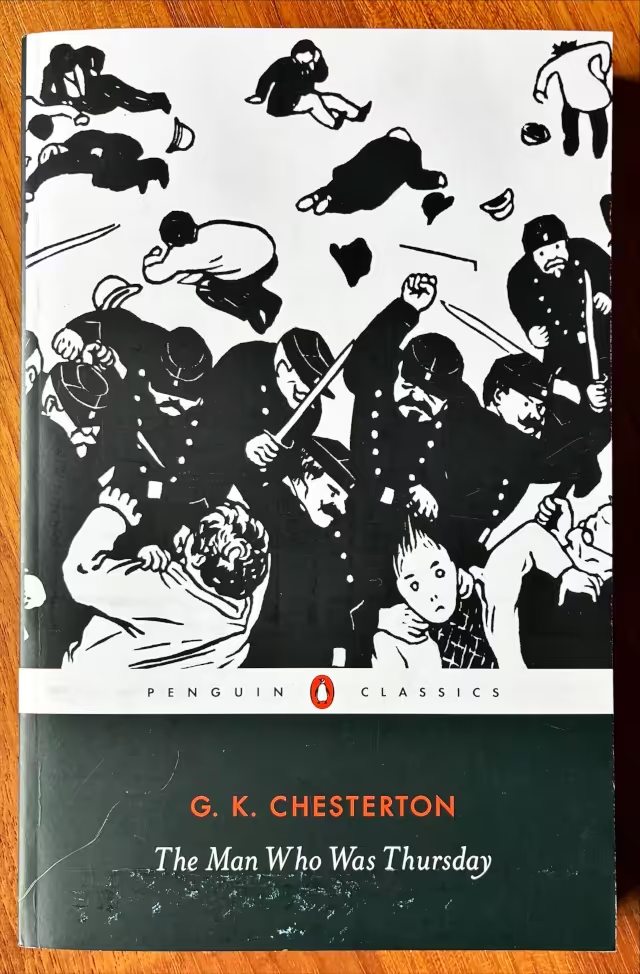 The Man Who Was Thursday: A Nightmare by G. K. Chesterton,
1908
The Man Who Was Thursday: A Nightmare by G. K. Chesterton,
1908181 pages. Penguin Classics; 2011 trade printing.
ISBN 978-0-141-19146-1
Finished The Man Who Was Thursday: A Nightmare tonight, including the (postponed) publisher's preface which contained spoilers. I'm glad Penguin put the warning at the top and I got to come at it "clean". I anticipated some of the revelations, but the final form they took was, as is fitting a nightmare, completely unexpected — a bolt from the blue, so to speak. I confess I kept trying to figure out whether and what the allegory was, and trying on different alternatives went from enjoyable to somewhat tiresome. I suggest the reader just take it as it is, again like a dream, and wait to the end to attempt interpretations. It's a short, quite enjoyable read. The prose is colorful and witty, the dialog often a bit silly, and the tension very real. You get the sense that anything can happen, and share the protagonist's anxiety at this realization. Definitely a book worthy of multiple readings. Recommended.
3-Feb-2026
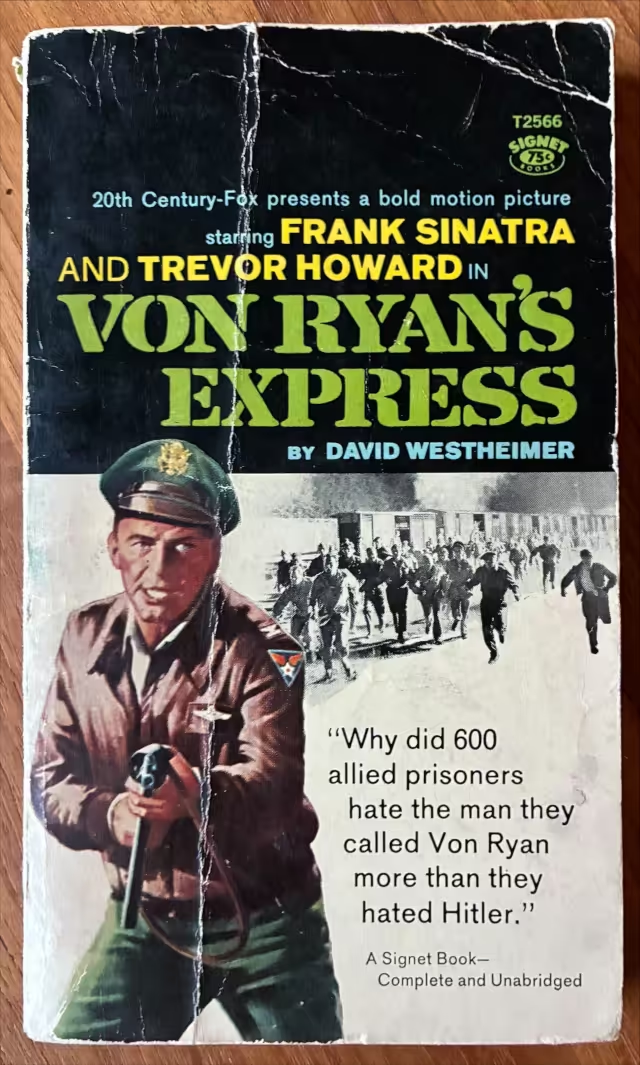 Von Ryan's Express by David Westheimer, 1964
255 pages. Signet; fifth paperback printing.
No ISBN
A fun, compelling tale of Joseph Ryan, a USAAF colonel, sent to an Italian POW camp. As the ranking officer, he takes charge of a slovenly, disorganized, undisciplined combined unit of American and British officers (and a few Other Rank enlisted men), becoming instantly unpopular for his insistence on discipline and order. In direct contradiction of the British lieutenant colonel formerly in charge, he mandates the men show respect to officers on both sides of the fence, and parlays this into concessions from the camp commandant, also a colonel. These include full Red Cross rations, uniforms, and reciprocal respect for Allied officers by camp staff. But his nearly 1000 men are used to slacking off and haranguing their captors, and resent having to shave, clean, and form up in ranks for inspection. Just about this time, the Italians surrender, and things get messy. No one has any orders regarding what this means for the camp. They can't release Allied combatants into what is still a war zone — German troops still operate in the Italian theater. The Allies, and most of the Italians, don't want to let Germany know there are a thousand Allied POWs in a lightly-guarded camp, so they lay low. But eventually, the Germans capture the camp and load the prisoners in boxcars for transport to Germany. Ryan comes up with a daring plan to take the train and escape.
The characterizations are strong and you get a good feel for the social dynamics in the POW camp. Ryan is an unimpeachably dedicated hard-ass, with immense personal dignity, who gives his best and expects the same from everyone else. This is apparent from the opening pages, when he, a captured enemy airman, berates the guard of his soon-to-be prison for his slovenly dress and general lack of discipline. He takes charge of the camp immediately, without regard to how things have settled prior to his arrival. He knows his duty, and the duty of his captors, and pursues these doggedly, despite near-universal dislike. The story is compelling, and only a bit far-fetched. You are really rooting for Ryan to succeed in rescuing his charges, even when they are resisting him. It was made into a movie with Frank Sinatra in the title role — great casting, if you ask me. I have not seen the film, but it's on my watch list if it ever comes up on Amazon Prime. Recommended.
27-Jan-2026
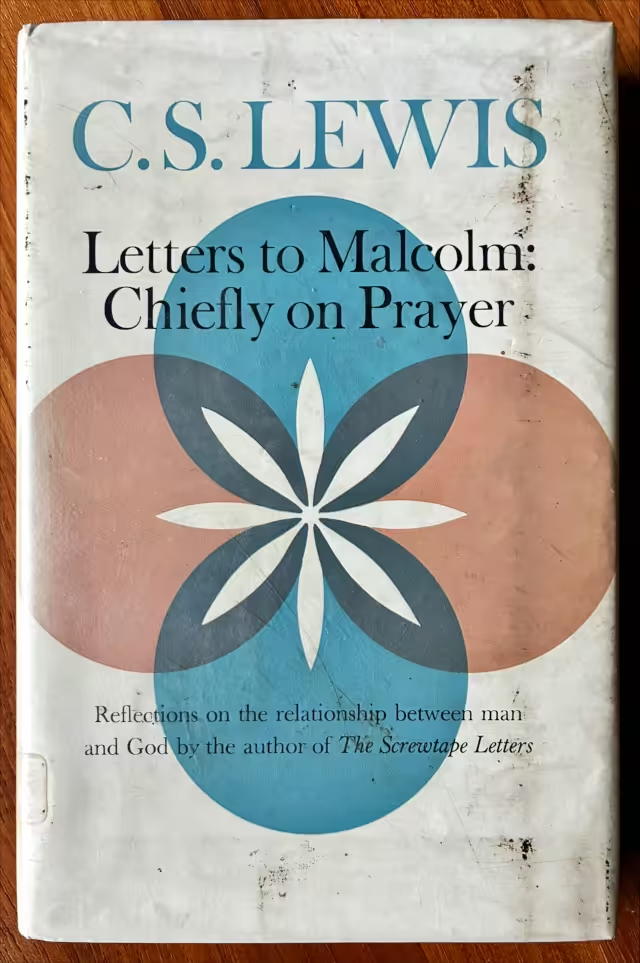 Letters to Malcolm: Chiefly on Prayer by C. S. Lewis, 1963
124 pages. Harcourt, Brace & World; First American edition.
No ISBN
This was the February selection for the Beaverton C. S. Lewis Society. I had never read it before, and didn't know until someone told me at the meeting that there is no Malcolm. Lewis once again has made verisimilitude an art, and rendered one side of a months-long conversation with a completely fictional correspondent. I assumed he might have added a bit of context here and there to make sure the reader could grasp the gist of what Malcolm had said, but instead it was all invention. Anyway, regardless of its structural qualities, the book is also an excellent investigation into the nature and practice of prayer, from liturgical corporate prayer to closed-door adoration and petition. Lewis is his usual unguarded self, raising and attempting to answer the most troubling and perplexing questions regarding how we address God and whether, when and how He responds. And indeed, how much of our prayer life is just God talking to God with us as the instrument, as the Spirit intercedes for us. But none of it is high-minded theologizing — it is instead a real man talking to his (admittedly imaginary) friend about his real experiences, impressions, and feelings. At just 124 pages, I thought I'd breeze through it, especially when I saw that a lot of them contained only "orphaned" paragraphs at the beginning or end of chapters. But there's so much depth here, I had to read it over twice before attempting to engage with the questions presented for group discussion. Highly recommended if you're up to it.
26-Jan-2026
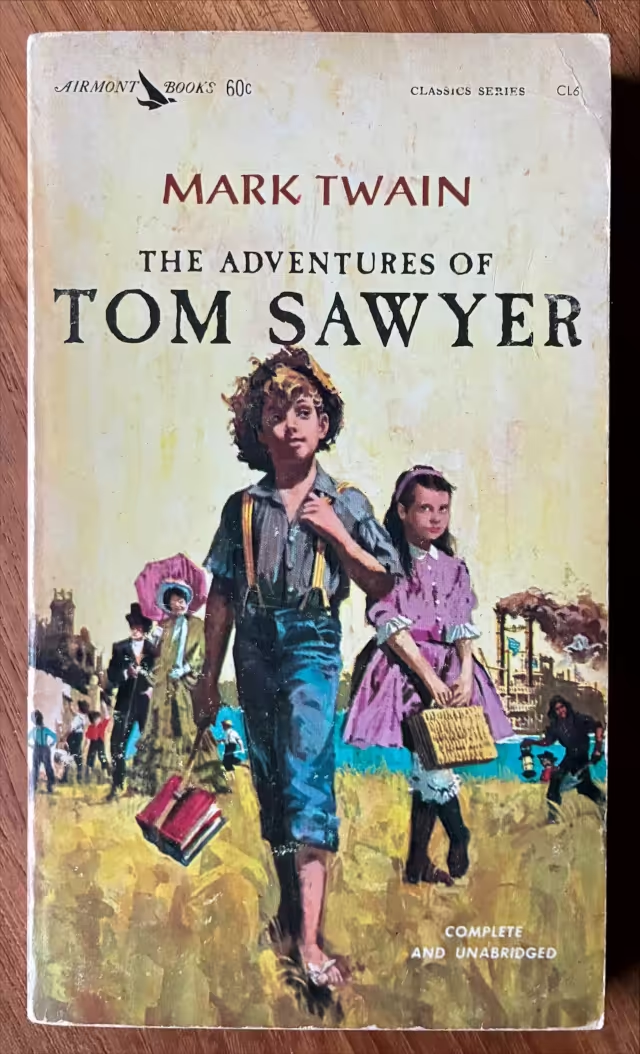 The Adventures of Tom Sawyer by Mark Twain, 1876
222 pages. Airmont Books; 1962 paperback edition.
No ISBN
I had never read this as a child, so when it came up in the library-on-a-stick, I grabbed it. It's an easy read (intended, as it is, for youth), but neither as clever nor as offensive as I had been lead to believe. Tom is at times winsomely shrewd, but is more often just lazy and inconsiderate. Societal flaws are on display, but Tom stands firmly within society, rather than judging it from above, so the reader is left to make his own judgements. There are a few instances of "the n-word", but the book does not appear to be the racist holdover I had been lead to expect. It seems instead only to obliquely reference the accepted hierarchies of the time, including those based on race — and these are ancillary to the story. Tom doesn't hate black slaves, but he acknowledges their low estate, just as he recognizes the status of people society favors, like judges and senators. And in a certain sense, he does so innocently — Tom didn't build the institutions and hierarchies, and his complicity is largely (though not entirely) unexamined. If anything, Twain's matter-of-fact presentation encourages the reader to consider how future generations might view unsavory aspects of our own society which we to some degree tolerate. In Tom, we may get a glimpse of Twain's own boyhood, with his nascent tendency to kick against the goads, but also his naïve acceptance of the world he was born into, which he only later came to question. All in all, it is a well-written and engaging book that conveys the outlook and attitudes of boyhood well, only in exaggerated relief for humorous effect. Recommended.
25-Jan-2026
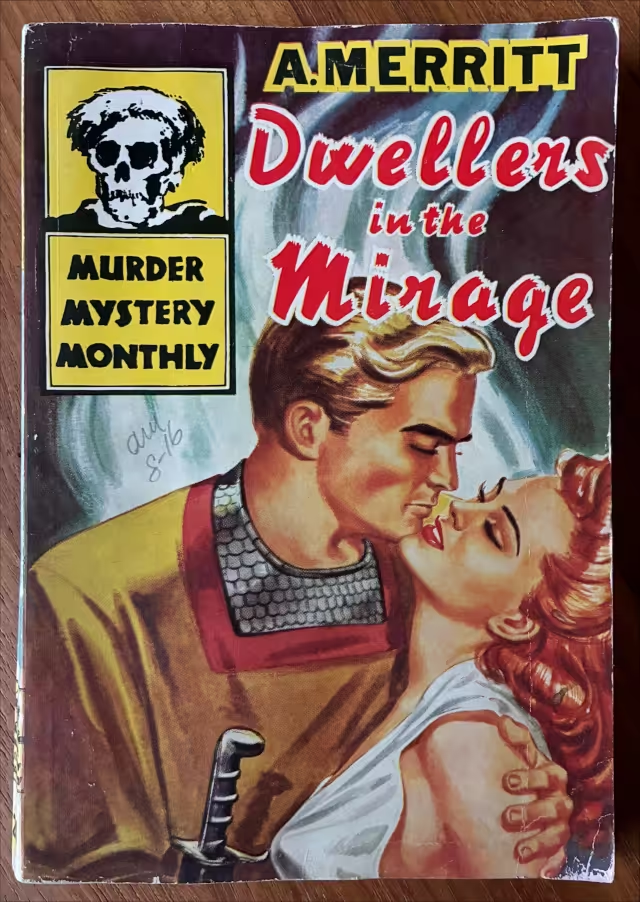 Dwellers in the Mirage by A[braham] Merritt, 1932
158 pages. Avon Books; 1944 paperback edition.
No ISBN
Unsurprisingly, this is not a great book. But, while pulpy and lurid, it is at least adventuresome; a lesser example of the kind of books Haggard or Stevenson produced. Leif Langdon, an atavistic Swede, born to small, dark-haired parents but possessed of a massive frame, fair hair and blue eyes, is captured by Mongolian Uighurs who believe he is their long-awaited savior. He discovers they preside over the ruins of a lost civilization, which they hope he will renew by mysterious rites involving a black, tentacled monster he recognizes as the Kraken, but they call Khalk'ru. Leif escapes, but unsure whether his experiences in the Gobi are real or hallucinations, he returns to the West, eventually winding up in a remote region of Alaska with his Cherokee friend Jim. They discover a hidden land underneath a mirage of rocky plain — a tropical paradise beneath the frozen landscape. Both Leif's and Jim's folklore inform their discoveries therein. They contend with miniature natives, fearsome Amazons, and mysterious priests of Khalk'ru. Leif must battle his own genetic memories that threaten to drown his identity in that of Dwayanu, the ancient high priest of Khalk'ru. While the book has interesting elements, its narrative thrust wanders, and it lacks moral clarity. It ends up being little more than a fantastical B-movie plot. Not recommended.
14-Jan-2026
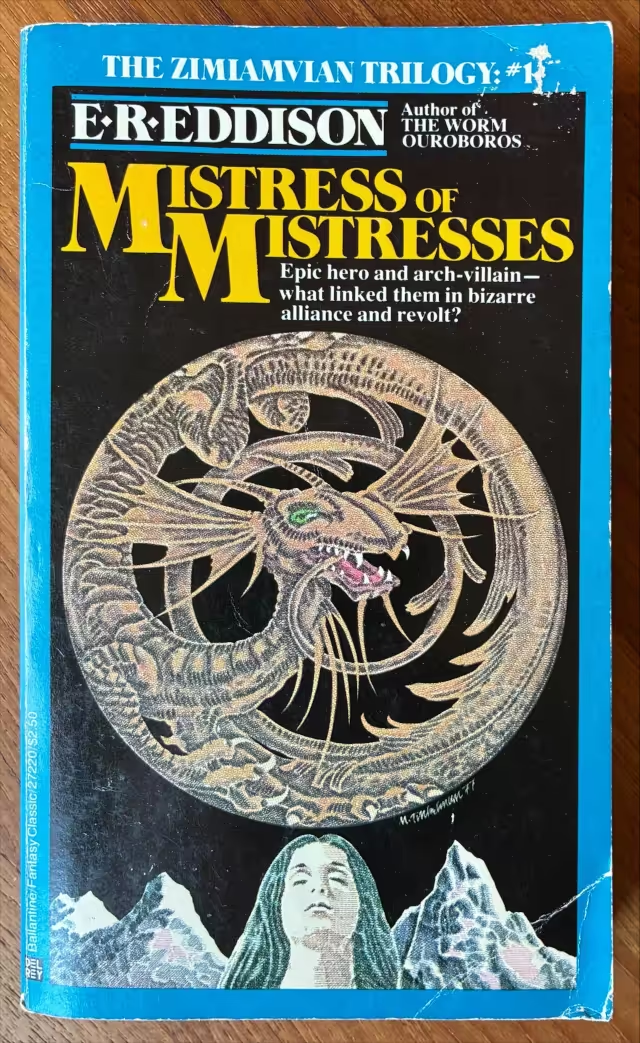 Mistress of Mistresses by E. R. Eddison, 1935
401 pages. Del Rey Books; 1978 paperback 4th printing.
ISBN: 0-345-27220-X
The Zimiamvian Trilogy: #1
Like The Worm Ouroboros, this book is written in Jacobean English, with frequent ancillary clauses, long and descriptive, interspersed within the narrative. I found it difficult to read under good conditions, and nigh impossible when distracted, even by my own internal dialogue. It also demands a good deal of attention to follow the story, which can shift between reality and realms of dream or magic. Also, the characters are many and variously referenced: by title, name, or relation. There are many references to Greek and other poetry (Sappho being the most frequent), but most of the foreign-language content comes with a translation (except French for some reason). But even with all these caveats, the book holds one's attention: why is Lessingham in league with such a rogue as the Vicar? What is his connection with Duke Barganax and Fiorinda, or Queen Antiope? What is the nature of Doctor Vandermast's seemingly extra-planar cottage, and why are nymphs and fey creatures his frequent companions? Alas, the answers to these questions are only hinted at in this first volume, though the author states explicitly (on the back cover) that this is a world created by Aphrodite for her Lover. It may well be that she inhabits both Fiorinda and Antiope, and her Lover both Barganax and Lessingham. Perhaps the rest of the trilogy will tell. Recommended, but with serious caveats.
9-Jan-2026
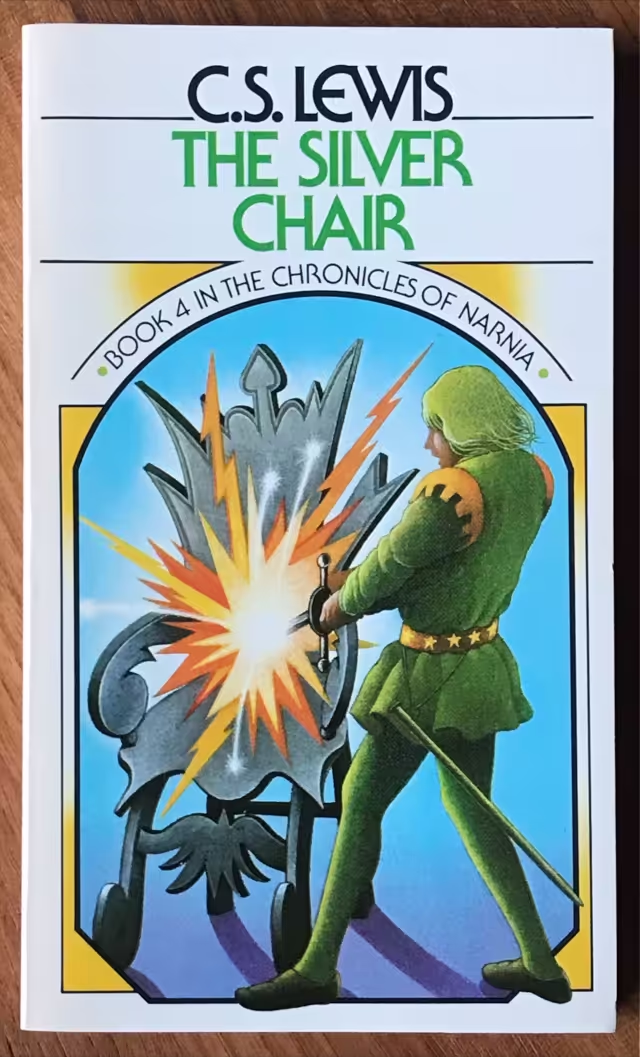 The Silver Chair by C. S. Lewis, 1953
217 pages. Collier Books; 1970 paperback edition, 40th printing.
ISBN: 0-02-044250-5
Book 4 of the Chronicles of Narnia
I re-read this classic for the C. S. Lewis Society of Beaverton January 2026 meeting. I was struck by how plainspoken and accessible it is (being a children's book) while simultaneously conveying such profound concepts. For example, when the children hear they are to be welcomed to a feast by the Gentle Giants, they not only forget their duty, but become even more discontented with their surroundings and each other. Anticipating comfort distracts from both duty and present enjoyment. When the witch tries to enchant them all into disbelieving in Narnia, or anyplace other than the Underworld, their own concept of something better is what convinces them she's wrong. This is a potent illustration of the notion that our own material experience is merely a shadow or copy of the Reality we all long for, and indeed were made for. Throughout the book, death is portrayed as a journey from these shadow-lands into Aslan's Country, where everything (including us) is perfected. The children "muff" most of the signs given to them by Aslan, typically by being lazy or distracted, yet they still succeed in their quest (though perhaps with additional troubles) once they resolve to follow them. It's also notable that to follow the final sign and keep their word to Aslan, they must break their word to one another and release the Knight: there are levels of loyalty, which can come into conflict. Definitely recommended for both children and adults.